SaaS Link Building: Where Each Tactic Fits, and How to Check a Site Before You Pay
 November 10, 2026

Search for SaaS link building and you'll find agencies ranking themselves first on their own "best agencies" list, guides with 36 or 40 tactics, an ROI calculator idea for every product category, and podcast tips for founders who barely have time to ship the next release. Paid placements on other software companies' sites show up rarely, usually as one line inside an agency listing. None of these pages tells the in-house buyer how to check that link before the money leaves their card.
This guide is for the person doing the job: an SEO, a growth person or even a founder who builds links for a software product and has to justify every dollar. You've probably already seen the Google results and the AI answers. They list agencies and earned-link tactics, and they treat link insertions on other software companies' articles as an afterthought, if they mention them at all.
I've been building links for more than ten years, at GetFoundXL, then at my agency ClickCrab, and now with LinkVendors. Here I give each common SaaS tactic an honest place, including paid link insertions on real SaaS company sites, which the ranking guides skip. I also share the red flags I look for and a checklist to run on any site and article before you pay.
Paid link insertions belong in a normal SaaS link building plan. What makes them white hat is the kind of site you buy on and the process you follow. Whether money changed hands doesn't decide it.
The links that move a SaaS site come from other software companies' articles
Picture the articles your buyers read: the email tool's guide to cold sequences, the CRM's post on pipeline reviews, the design tool's tutorial on pitch decks. A link in one of those articles sits where your future customers already spend their time.
These sites belong to real brands with a real business model (selling software). Content is just one of their acquisition channels. That's what makes their links worth having, and it's also why those links are hard to get.
Here's the test I use for any site: would a link from it still matter if its search traffic went to zero?
DR won't tell you whether a site passes that test. You have to look at the business behind the site.
Every SaaS link comes from one of eight routes, and each costs a different kind of effort
The ranking guides list dozens of tactics. In practice they come down to eight routes. Each one uses up a different resource: data, partners, engineering time, writing time, your own site, inbox hours or budget.
The labels below are rough judgements to help you compare the routes. They are not measured benchmarks.
| Route | Who does the work | Main cost | Control over the placement | Fits when |
|---|---|---|---|---|
| Digital PR and original research | PR person or agency, plus whoever owns the data | High, per campaign | Low | You have data or a story nobody else has |
| Integration partners and directories | Partnerships or product marketing | Low, mostly one-off | Medium | You have integrations and listings to claim |
| Listicle and "best tools" placements | Outreach person | Medium: pitches and follow-ups | Low | Your product fits a clear category |
| Calculators and small tools | Engineers, plus someone to promote them | High upfront, then upkeep | Low | You have dev capacity to spare |
| Guest posts | Writer plus outreach person | Medium to high: a full article per link | Medium | You have writers and a topic editors want |
| SaaS link exchanges | In-house link builder with access to your site | Your own pages and content | Medium | Someone in-house can edit your site |
| Cold outreach | Outreach person | High: inbox hours, falling reply rates | Low to medium | You have time and a strong reason to link |
| Link insertions | The seller places, you choose | Budget per placement | High, if you can approve the page | You want a specific link on a specific page |
Digital PR and original research earn rare links at a high cost per campaign
A data study or a strong story can earn links from news sites and big industry publishers that an outreach email would never reach. The cost sits in the campaign: research, design, pitching, and the risk that nobody picks it up. It works best when you have something only your company can publish, such as anonymised product data.
"But if you're looking for something like truly unique then already we are going to the levels of digital PR and that's something completely different from link building."
Give it its own budget line and its own goals. Don't judge it by cost per link, and don't expect it to fill the gaps on your product pages.
Integration partners and directories give you links you already qualify for
If your product connects to other tools, their integration pages and app directories often list partners with a link. Software directories and review sites work the same way. These are the quickest links you'll ever build, because you already qualify for them.
The catch is supply. Once you're listed, that route is done, and every competitor with the same integration gets the same link. Claim them all early, then move on.
Listicle and "best tools" placements depend on someone else's editor
Being named in a "best project management tools" article puts you close to the buying decision. People who read that page are comparing products. That's why these placements matter so much in SaaS.
You don't control them, though. The editor decides whether you're in, where you appear in the list, what the description says and when the next update happens. Pitch them, make your product facts easy to copy, and don't plan a quarter around them.
Calculators and small tools attract links slowly and need upkeep
A pricing calculator, a template or a small checker can attract links for years. Building one takes engineering time, and the links rarely arrive without promotion. Then it needs upkeep, because a broken calculator stops attracting links.
This route suits teams with dev capacity to spare and a tool idea close to the product. If your engineers are fully booked on the roadmap, park it.
Guest posts trade a full new article for one link
A guest post means writing a whole new article to get one link into it. Add the pitching, the editor's revisions and the wait for publishing. The new page then starts at zero: it isn't indexed yet, it has no rankings and it gets no traffic.
Guest posts still work when you have writers and a point of view editors want. Count the writing time as part of the cost.
SaaS link exchanges need someone in-house with access to your site
Traditionally, SaaS companies have been restricted to SaaS link exchanges, done either by an in-house link builder or through a link building agency. You link to a partner's article, and they link to yours. It costs no cash, but it uses up your own pages.
"[I]t's going to be in-house if you want to engage in [...] SaaS link exchanges, because the person will need to have access to your [...] content, to link out to things, to link things on [...] your site."
An exchange is a trade, so you pay for it with your own site. Every partner link you add is a link out from your pages, and you need pages the other side actually wants a link from. A trade also holds only while both links stay live, so someone has to keep checking both sides. The people you trade with are in-house marketers who get dozens of link pitches every day and usually aren't paid per link, so replies can be slow.
Cold outreach gets harder every year as reply rates drop
Cold outreach is the classic way to build links. The maths behind it has changed.
"[Outreach infrastructure] is getting less and less relevant every year with basically [...] two forces, [...] first of all, it's AI and just people mass spamming other people with emails. [...] so reply rates kind of drop."
This is an economic argument, not an ideological one. When reply rates fall and most sellers are already listed somewhere, every hour of cold email buys fewer links. Outreach still pays off for relationships: partners, journalists and people who already use your product.
Link insertions add your link to a software company's article that already ranks
A link insertion adds your link to an article that is already published. No new guest post gets written. The page is already indexed and often already ranks for multiple keywords.
That changes what you're paying for. With a guest post, you pay for a page that might rank one day. With an insertion, you can check the page, its traffic and the exact sentence before you commit, as long as the seller shows them to you.
Link insertions on real SaaS company sites belong in your core plan
A lot of SEO advice treats paid links as a grey corner of the plan. I think that view ignores where most companies actually stand.
"[M]any SEOs pride themselves in never [...] buying any links, but the situation is very different for [...] a huge enterprise [site] with DR80 or [...] a startup or [...] an e-commerce store"
A SaaS team with a product page on page two has three good reasons to buy insertions. First, the article already exists, so you can check its rankings and traffic. Second, you choose the context: the topic, the paragraph and the sentence. Third, you pay per placement, so every dollar maps to one page and one target, which makes the spend easy to explain.
Being white hat is about the kind of site and the process. That means a real business with a product, several traffic sources, a page you approved before you bought it, and no link farms.
Insertions don't replace the earned routes. Earned links build the brand. Insertions fill specific gaps, like the comparison page with no links or the integration page stuck on page two.
The kind of site decides whether a paid link is worth having
Insertion prices vary a lot by the type of site, and I cover that range in how to buy backlinks. A site worth paying for has a few things in common:
- It belongs to a software company that earns from its product.
- It's a real brand with several traffic sources, so its traffic doesn't depend on Google alone.
- Its audience matches yours. For most SaaS teams, that means English-language content read mostly in English-speaking countries.
- Someone checked it by hand before it was offered to you.
Big link marketplaces work the other way. They list 100K to 1M sites, and most of those sites exist only to sell links. The catalogue looks huge, but finding the few real businesses inside it becomes your job.
"I was so tired of these "grey niches welcome" sites, that I built LinkVendors"
Every site on LinkVendors belongs to a software company that earns from its product. Links there sit where real brands and editorial links overlap. All of them are in English, and most of their traffic comes from English-speaking countries.
Agencies, big marketplaces and SaaS-only marketplaces sell insertions in different ways
Since LinkVendors is my company, it's in this comparison, and I've aimed to keep it fair. There are three main ways to buy an insertion, and each one puts the work in a different place.
Agencies. Many agencies work from agreed requirements and don't let you approve sites before buying. Other agencies do let you approve each domain, but they don't show you their whole inventory the way a marketplace does.
Big marketplaces. You get a huge catalogue, and the filtering is up to you. Some of them now let you choose at page level, not just by domain. Insert.Link, for example, describes choosing from 50M+ indexed publisher pages.
SaaS-only marketplaces. You get fewer sites, and all of them are real software companies. On LinkVendors, the full inventory is visible and searchable, and you approve the exact article and sentence before you buy, not just the domain. That's the main difference from an agency. The difference from other marketplaces is the inventory: 1,000+ established software company sites instead of a catalogue of sites that exist to sell links.
Whatever you choose, compare prices across sellers.
I compare the best link insertion marketplaces on their insertion checks in a separate guide. The agency side is covered in link building services vs marketplaces.
SEO metrics are red flags to investigate, not hard filters
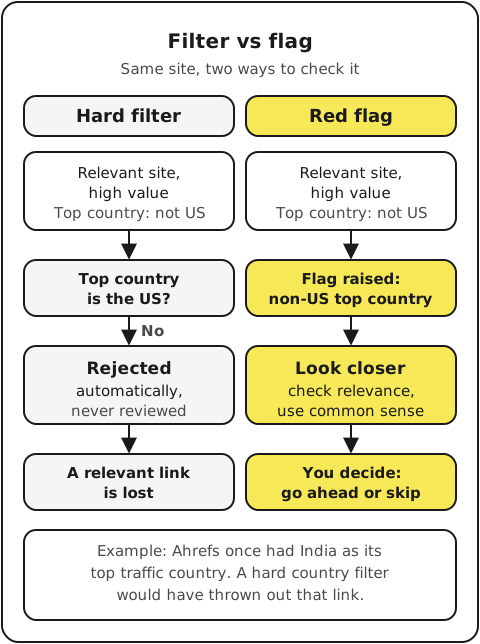
Most buyers start with DR, traffic and top country. Those numbers come from models, so take them with a grain of salt. I treat each one as a red flag that tells me where to look closer, not as a filter that rejects a site automatically.
"Look at the flags a site raises, then use common sense to decide whether to go ahead anyway."
Here's why. Ahrefs itself at one point had India as its top traffic country. A hard country filter would have thrown out a link from Ahrefs, which many people would want if it's relevant to their niche.
The flags I check most often:
- DR and traffic out of sync. DR 88 with about 1,000 monthly visits makes no sense. A huge brand with neglected SEO can look like that, but it's rare, and it usually means the link gives poor value.
- A recent traffic crash. A drop of 50% or more in the last six months needs an explanation. LinkVendors lets you skip sites whose organic traffic fell 50% or more in the last 6 months.
- Traffic value far too low for the traffic shown, or a site where just one article ranks.
- Ranking keywords that don't make sense. SEO tools estimate search volume, and Ahrefs says itself that every tool's numbers are estimates. In my experience, inflated volumes on random keywords are a sign to look closer.
- Too many linked domains. A site that links out to tens of thousands of domains passes less to each one. A site that blocks the Ahrefs crawler so you can't see this is a flag too.
- A bad neighbourhood. Outbound links to grey-niche sites, sitewide footer links or aggressive ads.
- Topical drift. The site started with a strong core topic and drifted into loosely related niches. The 2024 leaked Google documents show Google measures how focused a site is and how far its pages drift from its core topic.
Check six things about a site and article before you pay for a link
Every paid link is a small bet with real money. The most expensive mistake happens before the purchase, when a site that should have been rejected gets through.
The metric flags tell you where to look. These six checks are about the business, the page and the sentence. A fail on any of them usually means skip.
The site earns from a product, not from selling links
Open the homepage. Look for a pricing page, a signup or login button and a product people actually use. Search the brand name and see whether people look for it directly.
Then check the traffic mix in your SEO tool. If organic search is nearly all of it, run the zero-traffic test again.
The article is about a topic your target page belongs in
Topical relevance beats DR. A link from a mid-sized email marketing site to your email deliverability tool is worth more than a link from a huge site's article about something unrelated.
Read the paragraph, not just the domain. Ask whether a reader of that paragraph would click your link because it helps them. If you'd struggle to explain the link to that reader, skip it.
The page is live, indexed and not already linking your keyword elsewhere
Open the page. Check that it loads, isn't redirected and still shows up in Google when you search its exact URL.
Then use your browser's search to find your keyword on the page. If it already links to another site, an editor is unlikely to swap it out, and two links on one phrase helps nobody. Pick a different article.
The site does not sell a product that competes with yours
A competitor's site will almost never link to you, and even if a link got through, you'd be sending readers to a rival. Check what the site sells, not just what the article is about.
Your link reads naturally in the sentence it sits in
Read the exact sentence with your link in it. It should read as if the writer put it there.
You have two options. You can link words that are already in the article, or you can ask for a new sentence to be added. Linking existing words keeps the article untouched. A new sentence gives you more control over the anchor, but it has to fit the paragraph.
The price is fair for this one page, not just for the domain
Two articles on the same domain can be worth very different amounts. Judge the price against the page itself: its relevance to your target page and its own traffic. A strong domain with an irrelevant article is a weak buy.
Point paid links at the pages that sell your product
Your blog posts can attract links on their own. Your commercial pages rarely do, because people seldom link to a pricing or comparison page without a reason. Paid links do the most work there.
Prioritise in this order, then adjust for your revenue:
- Product and feature pages for the keywords people search when they're ready to buy.
- Comparison pages ("you vs competitor").
- Alternatives pages ("competitor alternatives").
- Integration pages, which match searches like "tool A + tool B".
Let the sentence pick the anchor. If the sentence talks about "scheduling social posts in bulk", link those words to the matching feature page. Forcing your exact keyword into a sentence that doesn't call for it is what makes a link look bought.
When I describe what's expected from a link builder paid around $4k a month, this is the core of it:
"It's the strategy, the [4K one] is [...] expected, of course, to have some sort of strategy to [...] tie everything into [...] revenue[,] how to prioritize which pages to build links to"
Competitor backlinks and keyword search both point you to the articles worth targeting
The manual way works. The link gap reports in Ahrefs and Semrush compare your backlinks with those of the companies you compete with. They list the sites that link to those companies but not to you.
Then the slow part starts. You open each site, check whether it's a real business, find the right article, find the contact and ask for a price. Most of the list drops out along the way.
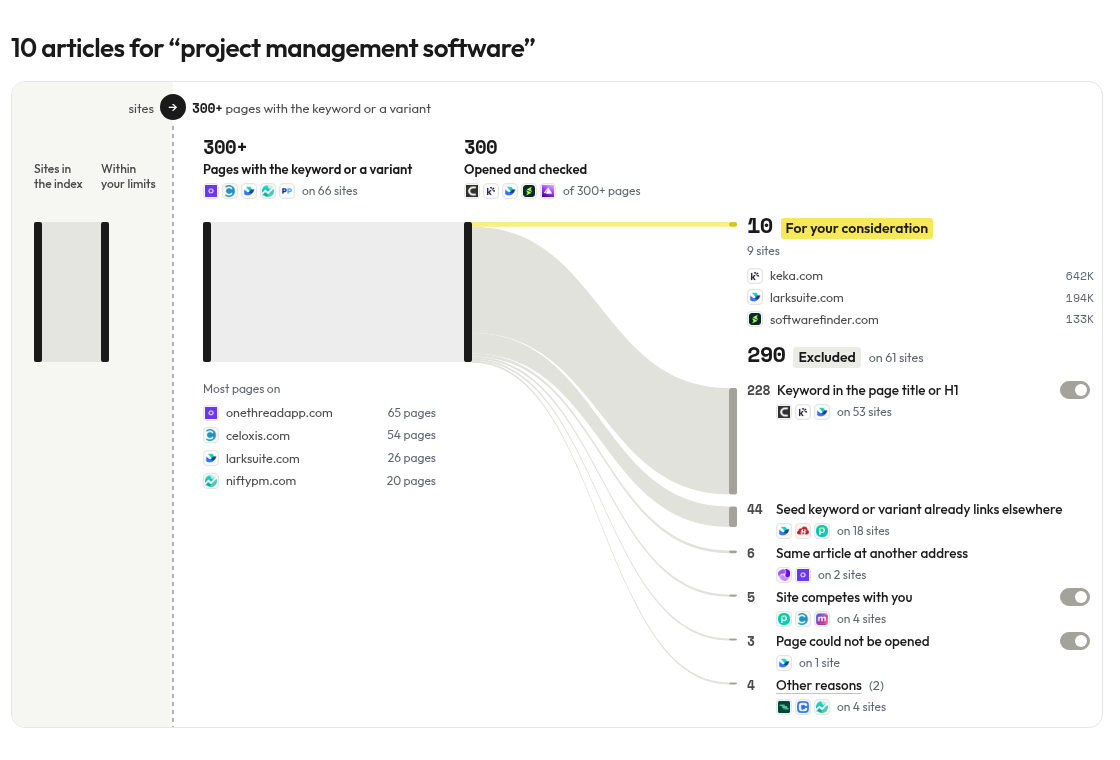
On LinkVendors, you start from a keyword instead. You search for it and add the page you want links to in the "Page to promote" field. An AI check then opens the matching pages and leaves out the ones that fail the basics, such as pages where your keyword already links elsewhere and sites that compete with you.
A LinkVendors order goes from search to live link
LinkVendors is a link insertion marketplace with 1,000+ established software company sites. You search 1M+ published articles by keyword, and each result shows the sentence with your keyword, the site's DR and traffic, and the price. You approve the exact article and sentence, then add your target page and anchor text. We place links through the editors and link builders who already work with these sites, and publishers have the final say.
You pay upfront by card and get a refund if the link doesn't go live. We aim to get links live within 45 days. Prices start from $250 per link and depend on the site.
To see which sentences are available for your own keyword, search by keyword on LinkVendors.
One in-house person plus a marketplace is the best starting setup for most SaaS teams
Since I run a marketplace, keep my bias in mind here. My view is that for most companies, the best starting point is one person in-house plus a marketplace. In SaaS, ecommerce or tech, that means a marketplace like LinkVendors.
How it plays out depends on who you are:
- A founder doing links alone. Claim your integration and directory links first. Then put a small budget into insertions on your few most important commercial pages. Save digital PR until you have data worth publishing. See link building for startups.
- An in-house SEO or growth lead. You own the strategy and the target page list. Run exchanges and relationship outreach yourself, and use a marketplace to fill the gaps on specific pages.
- A team already using one or more agencies. Check for overlap first, because several agencies on one account can end up stepping on each other's toes.
If you keep an agency, give it one clear job, such as digital PR, and approve paid placements yourself. Before you hand any of this off, read what to verify before you outsource.
AI filtering cuts the list down, but a person still makes the call.
LinkVendors is the wrong tool for some SaaS link goals
Some goals need a different tool:
- Truly unique coverage. If you want a story in the news or links from big publishers, that's digital PR. Hire for it.
- Grey niches. If you're building links for grey-niche sites, LinkVendors is not for you.
- Industries outside SaaS, ecommerce or tech. A marketplace that specialises in other industries and has a much larger catalogue is the better fit.
- New articles. LinkVendors is a marketplace for link insertions in existing articles. If your plan needs new content written on other sites, look at guest posts.
Ask two questions before you pay for any link
Ask these two questions before every purchase.
First: does the site pass the zero-traffic test from the start of this guide? A real software company that earns from its product does.
Second: would you approve this exact sentence on this exact page? If you can't see the sentence, you can't answer, and you're paying for a link you haven't checked.
If both answers are yes, buy the link. If either is no, skip it. Search by keyword on LinkVendors to see the sentence, DR, traffic and price for articles on 1,000+ established software company sites.