Link Building Services vs Marketplaces: The Real Difference Is Who Picks the Site, and When You See It
 November 10, 2026

A link building service will happily sell you something like $1,500 for a package of around ten links and choose every site for you. A big link marketplace will show you 100,000 sites and let you choose, as long as you don't mind scrolling past grey-niche sites to find one that fits a software product. Neither was built for a SaaS team that wants to know exactly where its links will go.
If you run links for a SaaS company, or you own an SEO agency, you search "link building services" because you need links and someone to get them. Most of the pages that rank for that search are written by services, and many are services reviewing other services. All of them assume you'll hire someone.
I've been building links for more than ten years. Since 2023 I've run ClickCrab, a link building agency, and I now also run LinkVendors, a link building marketplace. So I've seen both buying models from the inside, and I have a stake in both. I've aimed to keep this fair.
The real difference between a service and a marketplace isn't the price. It's who picks the site, how much of the inventory you get to see, and whether you see the site before you pay or after.
A link building service sells you the work, a marketplace sells you the placement
A link building service is an agency that does the work for you. You send a brief: your target pages, maybe some anchors, a budget. The agency finds sites, vets them to its own standard, negotiates with site owners or editors, arranges the copy and sends you a report of live links.
Agencies charge per link. That price covers the placement and all the labour behind it: prospecting, vetting, outreach, negotiation, writing and reporting.
A marketplace sells the placement itself. You search a catalogue of sites, each with a price, and you choose the site you want. The marketplace or the seller then places the link.
With a marketplace you do the choosing, and so you also do the vetting. That one shift changes almost everything else about the purchase.
The biggest difference is whether you see the site before you pay or after
With many services, you meet the site in the report, once the link is already live and paid for. If the agency's idea of a good site differs from yours, good and bad links get mixed, and you can't pull out the bad ones.
With a marketplace, you see the site before any money moves. A site you wouldn't want never makes it into your basket.
This matters because every link is a spending decision. On the agency side, a costly mistake can happen early, at the prospecting stage, when a site that shouldn't be on the list gets through:
"[I]f you make a mistake during prospecting and a site that has no business [...] linking to our client gets [...] whitelisted, and we pursue a link from this site, and then maybe we need to [...] pay for that link, and then we look at the situation and we realize that, well, [...] we shouldn't have been really paying"
When a service does the prospecting, that mistake is made on your behalf. When you buy from a marketplace, you make the call yourself, before you pay.
Most agencies either work from agreed requirements or show you a drip of domains
Many agencies, including my own agency ClickCrab, don't let clients approve sites before buying and instead agree all the requirements up front, even unusual ones, before prospecting starts.
Other agencies let you approve every domain but show only a small slice of their inventory at a time, which I cover in LinkVendors vs a link building agency.
An approved domain is still not the article and the sentence
Even a domain you chose from a full list leaves a lot out. It doesn't show you:
- the page your link will sit on, or whether that page is live and indexed
- the sentence around your link, and whether your anchor reads naturally there
- whether that page already links your keyword to someone else
- whether the site sells a product that competes with yours
A strong domain can carry a weak page. A good page can already link your keyword to a competitor. When a service says "you approve every placement", ask exactly what you'll see at the moment you approve: a domain, a page, or the sentence.
Services and marketplaces put the work in different places
Both models get you a link on someone else's site. The difference is who does each job, how much you see, and when you find out what you bought.
| Link building service | Link building marketplace | |
|---|---|---|
| Who finds the sites | The agency's team | You, by searching the catalogue |
| Who vets the sites | The agency, to its own standard | You, plus any filtering the marketplace does |
| How much of the inventory you see | Often none; some show a drip of 10 to 20 domains at a time | The whole catalogue, searchable |
| Who negotiates | The agency | Nobody: you buy at the listed price |
| Who writes the copy | The agency's writers or the site's editor | Depends on the marketplace and the type of link |
| When you see the site | In the report after the link is live, or as a domain shortlist | Before you pay |
| How you pay | Per link, often as a package, on the agency's terms | Per link, at the listed price for that site |
| If a link doesn't go live | Depends on your contract | Depends on the marketplace |
A service carries more of the work. A marketplace hands you the choice, and the responsibility for it.
Per-link prices mean different things in each model
An agency's per-link price bundles two things: the placement, and the labour of finding and securing it. A marketplace price is for the placement on one specific site. So the two numbers aren't directly comparable, even when they look similar.
Agencies often sell links as packages, something like $1,500 for a package of around ten links, and you can't really select which links you get. With cheaper packages you can sometimes filter by metrics. The catch is where those links come from: sites the agency has bulk deals with, buys in bulk and resells to many clients, or sites with inflated metrics.
Keep link types apart when you compare. Guest posts and link insertions are different products, with different work behind them, and they shouldn't sit in one range or average.
Neither model costs less by default. The number that matters is the cost of each link you'd actually keep. A link on a site you'd have rejected costs the full price and returns nothing, so each good link in the batch quietly carries part of its cost.
A link building service is the better choice in four situations
A marketplace isn't the right answer for every team. Here's when I'd hire a service instead.
You have nobody in-house who can judge a site
A marketplace hands the vetting to you. If nobody on your team can tell a real brand from a link farm, that's a risk, not a saving.
In that case a service with a good process is the safer buy. You pay for someone else's judgement, and with a requirements-upfront agency you get that judgement written down before work starts. Make sure the requirements are specific enough to hold the agency to them (see the list below).
You need a strategy, not only links
Deciding which pages need links, in what order, and how that ties to revenue is a job in itself. It belongs to a service or to a senior person in-house. A marketplace sells placements, and it won't tell you where to point them.
Here's how I've described what a link builder paid around $4k a month is expected to bring:
"It's the strategy, the [4K one] is [...] expected, of course, to have some sort of strategy to [...] tie everything into [...] revenue[,] how to prioritize which pages to build links to"
If you don't have that person, a service that does the strategy well is worth paying for.
You need coverage nobody sells off a shelf
Some links can't be bought from a catalogue, because nobody has written the story yet. That's coverage built on your own data, research or news.
"But if you're looking for something like truly unique then already we are going to the levels of digital PR and that's something completely different from link building."
Marketplaces don't do digital PR. If that's what you need, hire people who specialise in it.
You run an agency and want fulfilment you never touch
If you own an SEO agency, white-label fulfilment lets you resell finished links without staffing a vetting team. For some agencies that's the right trade.
Be clear about what you give up. You often don't see each site before your client pays you, and your client sees the links only when the report arrives. Your reputation rides on someone else's prospecting.
If you hire a service, get these things agreed before you sign
A service can work well. Problems are easier to avoid when the terms are agreed at the start. Get these in writing:
- Approval or requirements. Either you approve sites before purchase, or every requirement is agreed in writing before prospecting starts. If approval is offered, ask whether you'll see the full list or a drip, and whether you approve the domain, the page or the sentence.
- Where the sites come from. Ask whether they're sites the agency buys in bulk and resells to many clients.
- Pricing split by link type. Separate prices for guest posts and link insertions, not one blended package rate.
- What happens if a link is removed or never goes live. A replacement, a refund, or nothing. Ask how long the agency covers a link after it goes live.
- Who owns the relationship with the site. Whether you can go back to that site yourself, or only through the agency.
- What counts as a site the agency won't use. Their exclusions, in their own words, so you can hold them to it.
I've put my own pre-payment checks, and how to read each metric as a red flag rather than a hard filter, in what to verify before outsourcing link building.
A marketplace is the better choice when someone on your team can judge a site
The self-serve model works when you already have the judgement in-house. That's usually true for two kinds of reader: the in-house lead at a SaaS company, and the agency owner with a team that vets sites.
You approve every site before money moves
You don't get a mixed report, because every link in it is one you chose. If a link disappoints, you know whose call it was, and you can fix your criteria.
What to do next: write down your criteria before you open any catalogue. Decide what kind of site you'll accept, which niches you won't, and what the page needs to be about.
You already know which pages need links and with which anchors
In-house teams usually know their money pages. You know which feature page is stuck on page two and which comparison page needs help.
A marketplace lets you match that target page and anchor to one specific article. You aren't hoping an agency reads your brief the way you meant it.
Most people who sell links are already listed on a marketplace
The economics of doing outreach yourself have got worse. Mass email, much of it written by AI, has pushed reply rates down:
"[Outreach infrastructure] is getting less and less relevant every year with basically [...] two forces, [...] first of all, it's AI and just people mass spamming other people with emails. [...] so reply rates kind of drop."
At the same time, the people who sell links have mostly moved to marketplaces:
"All the people who basically want to sell links, they're already in some kind of marketplace. And so [...] the economics don't really make sense anymore to reach out to people yourself."
Agency owners can show the client the exact site before buying
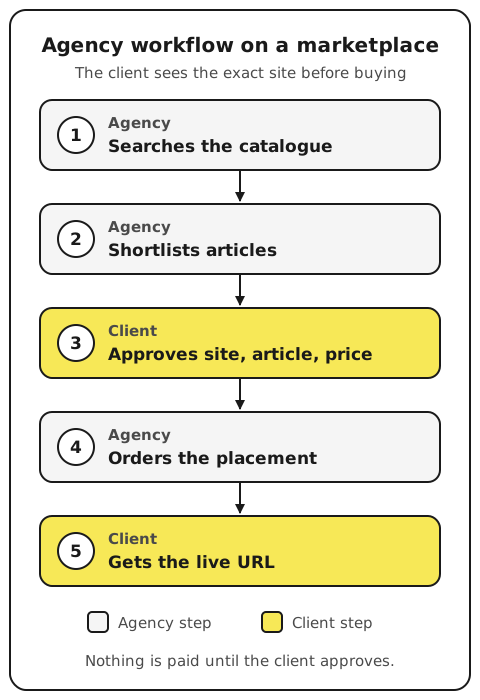
For an agency, a marketplace works as a sourcing tool. You keep your margin and vet with your own team. You can send the client the exact site, article and price before anyone pays.
That changes the client conversation. You're no longer explaining a report after the fact. The client approves what they're getting, and you keep control of quality.
Most marketplaces trade the agency problem for a catalogue problem
Self-serve fixes the "seeing it after you pay" problem. It brings a new one.
Big link marketplaces list 100K to 1M sites, and most of them exist only to sell links. Many are grey-niche sites. For a SaaS company, that isn't the kind of link you're after.
"There's a lot of rubbish. On a marketplace with 100,000 sites you have to go really hard on the filters, and you'll still get junk."
That isn't a flaw in how they're run. If you're a SaaS company, or an agency link builder working with legitimate clients outside grey niches, these marketplaces simply weren't built for you. They were built for other buyers, which is the case I made in 4 best link building marketplaces for SaaS.
So the question isn't only "marketplace or service". It's also which marketplace, and what kind of sites it lists. I've compared several in the best link building marketplaces for link insertions.
The setup most teams end up with is someone in-house plus a marketplace
My own view, after running both: for most companies, one person in-house who can judge sites, plus a marketplace, is the best starting point.
"[F]or most people these days, I think the best starting point is somebody in-house and a marketplace."
The in-house person brings the judgement and the strategy. The marketplace brings the sellers who are already there. You don't pay agency labour for prospecting someone else has already done.
Some companies go the other way and hire several agencies at once:
"I know many companies [...] who are hiring [...] a bunch of agencies, and these agencies are then kind of stepping on each other's toes a little bit, is my experience."
Traditionally, SaaS companies relied on SaaS link exchanges, run by an in-house link builder or through an agency. Exchanges need someone in-house anyway, because that person needs access to your content to link out to partners. Every link you get through an exchange is paid for with a link you give from your own content. More on that in SaaS link building.
LinkVendors is a marketplace of 1,000+ SaaS company sites where you approve the article and the sentence
Since LinkVendors is my company, it's on this list, and I've aimed to keep the comparison fair. Here's what it does, why each part matters, and what to do with it.
Every site belongs to a software company that earns from its product, not from selling links
Every site on LinkVendors belongs to a software company that earns from its product, not from selling links. There are no sites built purely to sell links. My test is simple: if the site's traffic went to zero, the company would carry on.
We moved away from cheap blogs on purpose, and I explain why in how to buy backlinks.
Every site is checked by hand before it's listed. All sites are in English, and most of their traffic comes from English-speaking countries.
Why it matters: the catalogue problem described above goes away. What to do next: spend your vetting time on the article, not on whether the site is real.
You search 1M+ published articles across the full inventory
You can search 1M+ published articles on these sites by keyword. In the search form you also add your page to promote, the page you want links to, and it's used to leave out competitors.
The whole inventory is visible and searchable, so you approve only the one or two placements you want. This is the "finding the right article" problem that agencies charge for. What to do next: search for the keyword your most important page needs to rank for, and add that page as your page to promote.
An AI check removes competing sites, dead pages and pages already linking your keyword
Your search starts with every page that has your keyword or a variant. An AI check opens each page and takes out pages where your keyword or a variant already links elsewhere, pages with the keyword in the title or H1, the same article at another address, sites that compete with you, and pages that could not be opened.
You can also skip sites whose organic traffic fell 50% or more in the last 6 months. What's left is the list of pages for your consideration. The check narrows the list, but it doesn't make the final call: you do.
You approve the site, the article and the sentence before you pay
This is the difference from most agencies. You don't approve a domain from a shortlist, you approve the exact placement. Each result shows the sentence with your keyword, the site's DR and traffic, and the price.
You add the target page and anchor text for each link. You can ask to link words already in the article, or to add a new sentence. What to do next: read the sentence out loud with your anchor in it, and skip any that sound forced.
You pay upfront and get a refund if the link doesn't go live
Prices start from $250 per link and depend on the site. You pay the full amount upfront by card. If a link doesn't go live, you get a refund.
We place links through the editors and link builders who already work with these sites. We don't own or control the sites, and publishers have the final say. Once the link is live, we send you the article URL to check.
We list 45 days as the safe upper limit, not the norm. It's usually clear within about two weeks whether a deal will happen, and many links go live by about 30 days.
If you know the page you need links for, search by keyword on LinkVendors and see which articles fit before you decide anything.
LinkVendors is not for you if you build links outside SaaS, ecommerce and tech
If you're not in SaaS, ecommerce or tech, LinkVendors isn't the right fit. The same goes if your priority is grey niches. A bigger general marketplace that specialises in other industries, or a service that works in your niche, will serve you better.
Your team, your niche and when you want to see the site decide which model to buy
Budget matters less than it looks, because both models charge per link. What decides it is whether someone can judge a site, what niche you're in, and whether you need something no catalogue sells.
Nobody in-house can judge a site: hire a service and agree the requirements in writing
Pay for the judgement you don't have. Get either approval rights or a full written set of requirements into the contract before prospecting starts. Use the list above.
Someone can judge a site and you're in SaaS or tech: use a marketplace of real software brands
Put your in-house judgement to work on a catalogue where every site is already a real business. Approve the article and the sentence, then pay.
You need unique coverage: budget separately for digital PR
Treat it as a different job with a different budget. Neither a link building service nor a marketplace replaces it.
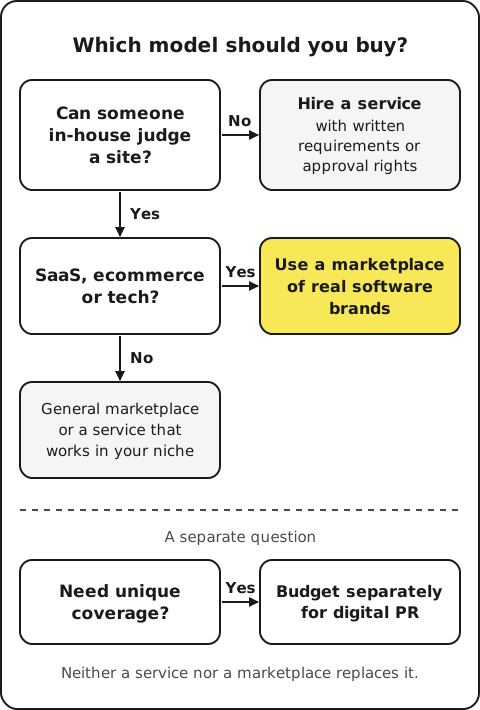
Before you buy from anyone, ask yourself two questions. Can someone on my team tell a real brand from a site that exists only to sell links? Do I want to see the whole inventory, and the site, article and sentence, before I pay, or am I happy to see them in a report?
If both answers are yes, search by keyword on LinkVendors and see which SaaS company sites already write about what you sell.