LinkVendors vs a Link Building Agency: Approve Every Link Before You Pay, or Let Someone Else Choose
 November 10, 2026

Some agencies say you approve every domain, but they drip a small list of about 10 to 20 sites so you pick something, they can resend the same list if you pick nothing, and they never show you their whole inventory the way a marketplace does. You approve, but only from the slice they chose to show you. On a marketplace, you see what's on offer before you pick.
This article is for the person who owns link building at a SaaS company, or who runs links for SEO agency clients. You already know which pages need links and which anchors you want on them. You probably have an agency proposal open, and you're checking whether a marketplace is the better way to spend the same budget.
Most "agency vs in-house" comparisons argue about cost and speed. I think the real difference is who chooses each link, and how much of the inventory you see before you choose. With most agencies, someone else chooses from requirements you agreed, or from a short batch of domains they show you. On LinkVendors, you search the whole inventory and approve the site, the article and the sentence before you pay.
Since LinkVendors is my company, it's on this page, and I've aimed to keep the comparison fair. I've been building links for more than ten years, and since 2023 I've also run ClickCrab, a link building agency, so I see this from both sides. An agency is still the better choice in some cases, and I cover those below.
Most agencies choose your links for you, and LinkVendors lets you approve each article before you buy
Both options end with a link on someone else's site. The difference is where your decision sits and what you can see when you make it. With an agency, you decide on requirements or on domains. With LinkVendors, you decide on the exact article and sentence, before you pay.
Many agencies agree requirements up front instead of letting you approve sites
A per-link agency usually works like this. You send a brief with your target pages, anchors and budget. The agency finds sites, does the outreach, gets the links placed and sends you a report.
Many agencies don't let you approve sites before they buy. My own agency works that way. At ClickCrab, we never let clients approve sites before buying. Instead, we agree on all the requirements up front, even unusual ones, before prospecting starts.
That model works when the requirements are clear and the agency sticks to them. But a requirement is a filter, not a choice. You still see the site, the article and the sentence for the first time in the report, once the link is live and invoiced. That's how good and bad links end up in the same report.
Agencies that let you approve domains usually show their inventory in small batches
Being able to approve every domain is a real improvement, and if you hire an agency, I'd look for it. The catch is how the domains are shown.
"They don't show you all the sites they could place you on. They drip it: 10 to 20 sites at a time, and you have to pick at least something. If you pick nothing, they send you the same 15 to 20 again."
The drip changes what you approve. Out of 100 sites, you might pick one or two. Out of a batch of 15 to 20, you also pick one or two, so batch after batch you end up approving more domains than you would from the full list. And you approve a domain, not the article or the sentence your link will sit in.
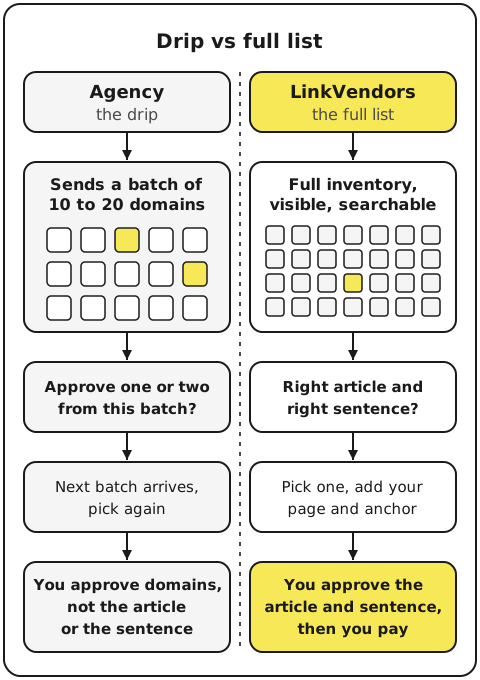
On LinkVendors you search the full inventory and approve the article and the sentence
On LinkVendors, the whole inventory is visible and searchable. Each result shows the site, the article, the sentence with your keyword, the site's DR and traffic, and the price. You pick the one you want, add your target page and anchor, and only then pay.
Nothing goes on your profile that you didn't look at first. If a site doesn't fit your brand, you skip it. If the sentence is a stretch, you skip it. The choice stays with the person who knows your pages best.
Paying per link for links you never approved is the real cost of an agency
Agency proposals quote a price per link. That number is easy to compare, so it's what most buyers compare. But it's the wrong number.
The number that matters is the cost per link you would actually have approved. Every link you didn't get to choose still shows up on the invoice.
Agency packages look cheap per link because you can't select the links
Link prices vary a lot by type of link. A typical agency offer is something like $1,500 for a package of around ten links. On paper that's about $150 a link, but you can't really select the links in a package like that.
With cheap packages, you can sometimes filter by metrics. Even then, the links tend to come from sites the agency has bulk deals with, placements bought in bulk and resold to many clients, or sites with inflated metrics. The per-link price only holds if you'd have approved every link in the package.
The links you wouldn't have approved aren't neutral either. They sit on your profile, they carry your anchors, and somebody on your team has to decide what to do about them.
To compare fairly, compare like with like. An agency price for a new guest post and a marketplace price for a link insertion are different products.
LinkVendors moved away from cheap link insertions on plain blogs
Link insertions on plain blogs that exist to sell links sit at the bottom of the price range, and you get what you pay for. One Google update can leave a site like that with no traffic and nobody who cares about it. LinkVendors moved away from the cheap blogs. We place links on sites that belong to companies with a real business model outside selling links, close to the editorial links a company earns on its own.
LinkVendors links start at $250 and the price depends on the site
On LinkVendors, links start at $250 per link, and the price depends on the site. Every link is a link insertion: your link is added to an article that's already published. The page is already indexed and often already ranks for multiple keywords.
Because you approve each link first, your cost per link and your cost per approved link are the same number. The point isn't a lower price tag. It's paying for links you chose.
You pay upfront and get a refund if the link doesn't go live
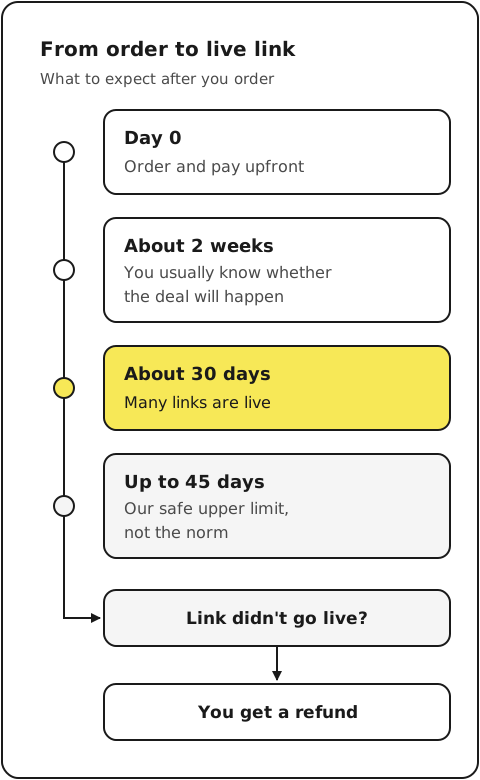
You pay the full amount upfront by card when you order. If the link doesn't go live, you get a refund. We place links through the editors and link builders who already work with these sites. We don't own or control the sites, and the publisher has the final say on every link.
Editors set the pace, and they have the final say on every link
Whether you use an agency or a marketplace, a person on the other side decides whether your link goes in and when. That shapes both timing and refunds. Here's what to expect on each.
45 days is our safe upper limit, and you usually know within about two weeks
We list up to 45 days to get a link live. That's us staying on the safe side, not the norm. You usually know within about two weeks whether a deal will happen, and many links go live by about 30 days.
The reason it takes time is the people on the other side. In-house marketers at software companies get dozens of pitches every day, from link exchanges to everything else. Most act in good faith and do their best. But they're usually not paid per link, so they have no reason to rush.
Most refunds happen because the editor sees you as a competitor
The most common reason a link doesn't go live is that the editor sees you as a competitor. You pick an article that's relevant to your niche and decide the site isn't a direct competitor. The editor may disagree.
"They're the ones who need convincing, and you probably won't change their mind."
There's a fine line between a relevant site and a competing one, and what you think can differ from what the editor thinks. Competition comes in two kinds. Commercial competition means a similar offer for the same audience. Search competition means one of their articles targets the same keyword as your page, even if that keyword isn't their main business.
Either kind can be enough for a no, and then you get a refund. Our AI check leaves out sites that compete with you, but the editor still has the last word. What to do next: when you shortlist, look at what each site sells and which keywords its articles target, and skip anything an editor could read as competing with them.
Finding the right article is the hard part, and LinkVendors search is built for it
When you pay an agency per link, part of what you pay for is one job: finding a relevant article on a relevant site that will take your link. That job is slow by hand. It's also where bad links slip in.
LinkVendors search does that job across 1M+ published articles on 1,000+ established software company sites. You search by keyword, add the page you want links to, and an AI check filters the results. Here's what each part does and how to use it.
Keyword search shows the exact sentence your link will sit in
Type a keyword, usually the anchor you want or a close variant. In the "Page to promote" field, add the page you want links to: it's used to leave out competitors. Results show the article, the sentence that contains your keyword, the site's DR and traffic, and the price.
This matters because the sentence is where your link lives. A great site with a forced sentence is a weak link. A good sentence on the right site reads like the author meant to link to you.
What to do next: run your main anchor first, then two or three close variants. Open the articles that fit, read the paragraph around the sentence, and shortlist the ones you'd be happy for a customer to read.
An AI check leaves out competing sites and pages that won't take your link
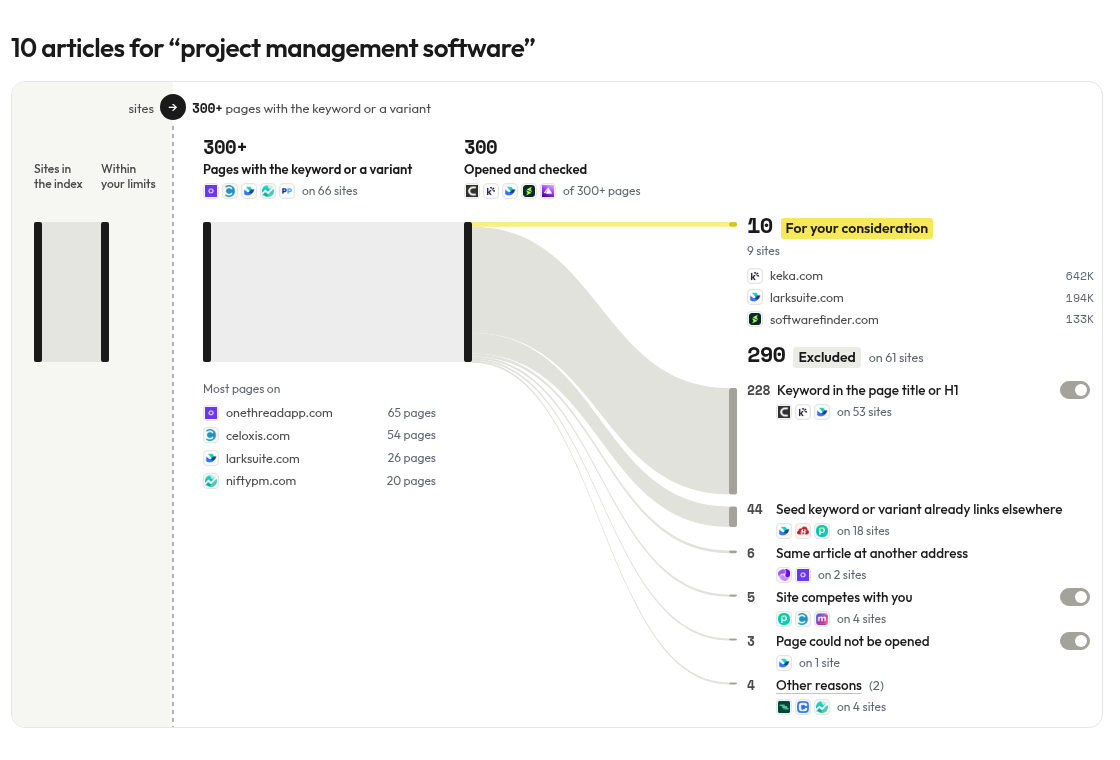
The AI check opens and checks the pages that contain your keyword or a variant. It leaves out the ones that won't work and lists each excluded page with its reason:
- your keyword is in the page title or H1
- the keyword or a variant already links somewhere else
- the same article sits at another address
- the site competes with you
- the page could not be opened
- other reasons
The funnel goes from every page with your keyword or a variant, to the pages opened and checked, to the ones left "for your consideration". What's left is the list worth reading.
What to do next: start your shortlist from what's left after the check, not from the raw results.
The final call stays with a person on your team
The AI check saves time. It doesn't replace the person who knows your product. You still read the sentence, look at the site and decide.
"Ultimately, I would say it's still not possible to replace a human fully. You can automate a lot of stuff but also you can't just remove them from making some decisions."
That's why approval is built into how you order. The tools narrow the list. You make the decision.
Every LinkVendors site belongs to a software company, not a site built to sell links
With an agency, the kind of site your link lands on is set by requirements or by a batch of domains. You rarely see the whole pool. So you find out what you got in the report.
On LinkVendors, the kind of site is fixed before you search. Every site belongs to an established software company that earns from its product, not from selling links. It's a real brand with several traffic sources, and its traffic doesn't depend on Google alone. All sites are in English, and most of their traffic comes from English-speaking countries.
Each site is checked by hand before it's listed. That's what white hat means to us: the kind of sites and the process, not a promise in a sales deck.
An agency is the better choice when you need work a marketplace can't do
LinkVendors isn't the right fit for everyone. In these cases, I'd hire an agency.
Nobody on your team has time to choose target pages and anchors
A marketplace assumes someone on your side knows which pages need links and which anchors to use. If nobody has that time or that skill, a marketplace will just sit unused. An agency can make those choices for you.
If you go this way, agree on every requirement in writing before prospecting starts. Ask whether you can approve domains, and if you can, ask to see the full list rather than a batch at a time. Ask what happens when a link doesn't go live, too, since sellers who take the money and stall are a pattern to watch for. Here's a fuller list of things to verify before outsourcing link building.
You need guest posts, new content or digital PR
LinkVendors only places links in articles that are already published. If you need new articles written, guest posts placed or press coverage earned, that's agency work. Digital PR in particular is its own discipline, quite separate from link building.
Your site is outside SaaS, software and tech
Every site on LinkVendors belongs to a software company. If you're not in SaaS, ecommerce or tech, and your priority is building links in other industries or grey niches, LinkVendors is not for you. An agency or a marketplace that specialises in your industry is the better fit.
You want one partner to own link strategy and reporting
A marketplace doesn't plan your link strategy. It won't decide which pages to prioritise, tie links to revenue or report to your board. If you want one partner to own all of that, an agency built around strategy is the right call.
LinkVendors fits teams that already know which pages need links
If you know your target pages and anchors, you don't need anyone to choose for you. You need a fast way to find the right article and a clean way to sign off. LinkVendors is built for two buyers.
SaaS in-house link teams that want to sign off on every link
You keep a list of pages that need links, with the anchors for each. You run each anchor through keyword search, with the page that needs links as your page to promote, so sites that compete with you are left out. You approve the links that fit, and you can see exactly what went on your profile and why.
You can ask us to link words already in the article, or to add a new sentence. Either way, you've seen the article first.
SEO agencies that place link insertions for SaaS clients
If you run an agency, you can show your clients the site, article and sentence before the link is placed, which most agencies don't do. Put each option in front of the client with the site, article, sentence, anchor and target page. The client signs off, then you order.
Your client sees what they're paying for, and you don't have to explain away a weak link in the monthly report. Every site is a real software brand, so the work holds up when a client checks it.
One person in-house plus a marketplace is the setup I recommend to most SaaS teams
"[F]or most people these days, I think the best starting point is somebody in-house and a marketplace."
For a SaaS company, that means one person who owns links, plus a marketplace like LinkVendors (which I run) for link insertions. Keep outside help for the work a marketplace can't do, such as digital PR.
The reason is economics. Doing outreach yourself made sense when reply rates were good. AI-driven mass emailing has pushed them down, and most people who sell links are already listed on a marketplace somewhere. So reaching out to sites yourself rarely pays off anymore.
One person in-house gives you someone who knows the product and makes every call. A marketplace gives that person the sites. For a wider view of the options, see link building services vs marketplaces and our guide to SaaS link building.
Ordering a link on LinkVendors takes five steps from search to live URL
- Sign in with your email.
- Search by keyword, or browse the inventory.
- Pick the article and the sentence.
- Add your target page and anchor text.
- Pay by card.
Then we take it from there. We place the link through the editors and link builders who already work with the site, and we send you the article URL to check once it's live. You usually know within about two weeks whether the deal will happen, many links go live by about 30 days, and 45 days is our upper limit. The publisher has the final say, and if the link doesn't go live, you get a refund.
You can run the same kind of search for your own anchor: search by keyword on LinkVendors and see which articles on software company sites already use it.
The decision comes down to who should choose each link
Skip the price-per-link debate. Apply two checks to each option on your list.
Check 1: who chooses. If someone on your team knows which pages need links and which anchors to use, that person should choose. Use a marketplace and approve every link. If nobody can, hire an agency, agree every requirement in writing, and if it lets you approve domains, ask for the full list instead of a batch.
Check 2: what you'd approve. For every link, look at the site, the article and the sentence. Then ask whether that link would still matter if the site's traffic went to zero. If you can't see those three things before you pay, you can't run this check, and good and bad links will get mixed.
When you read any comparison, including this one, it's worth remembering a line I give new link builders:
"[A]lways ask yourself, what are they trying to sell me?"
I'm selling LinkVendors. That's why the two checks above work for any vendor, agency or marketplace.
If your team already knows its pages and anchors, start with a search. Search by keyword on LinkVendors and approve the site, the article and the sentence before you buy. To compare us with other marketplaces, read best link building marketplaces for link insertions.