Common Link Building Scams: How to Verify a Seller Before You Pay
 November 10, 2026
Link sellers will happily offer you a placement in one of the world's best-known business outlets at a fraction of what it really costs. They'll offer a country edition of a famous magazine that has never existed, a "DR 70" blog whose readers are mostly bots, and a link exchange where only your side ever goes live. Some will sell you a real link on a real site that quietly disappears five days after you pay. Others send an urgent invoice, after a real order, for the link you already paid for.
Each of these is a pattern buyers run into.
This article is for the person who buys links for a SaaS company, in-house or at an agency, and is about to pay a seller they haven't used before. It's also for the person holding a prepaid order that has gone quiet and trying to work out what the silence means. You may have landed here from a search for link building scams, or from another article on our blog.
Most scam lists stop at the sales pitch. This one also covers what happens after you pay: the stall, the vanishing link, and how to pay so you still have a way back when either one happens. It also shows how to tell fraud from overpromising from a normal failure, so you know when to chase and when to wait.
I've been building links for more than ten years. I co-founded GetFoundXL, I've run the link building agency ClickCrab since 2023, and I built LinkVendors, a marketplace for link insertions on established software companies' sites. That means I sell links too, so read this with that in mind.
Most of these scams fail against two habits. See and approve the exact page before money moves. Then keep proof of every promise and keep checking the link after it goes live.
Link building scams come in four kinds: fake promises, fake sites, fake numbers and fake paperwork
Every scam below fits one of four kinds. Each kind has one check that catches most of it.
| Kind | What the seller fakes | The check that catches it |
|---|---|---|
| Fake promises | Access, delivery or permanence the seller doesn't have | Ask for a recent comparable placement on that exact site and a date when the order counts as rejected, then keep checking the link after you pay |
| Fake sites | A blog that exists only to sell links, or a lookalike of a famous outlet | Find out how the site earns money, and reach it from the publisher's own main domain |
| Fake numbers | DR or traffic that was manufactured | Check metrics under your own login, never from the seller's screenshot |
| Fake paperwork | Invoices for links you already paid for, aimed at whoever pays the bills | Match every invoice to an approved order note before paying, and confirm requests through a contact you already have |
Fake promises come first because they cost the most. The site can be completely real, and the seller's claim about it can still be false.
Fake promises cost buyers the most, because the money leaves before the deal is real
With a fake site, at least you get a link. With a fake promise, you often get nothing, or a link that lasts only until the seller has your money.
Take the money and stall: the seller sells placements they know they can't deliver
This is a pattern to watch for. A seller promises placements in a famous, high-authority outlet that they know they can't deliver. They take payment from several companies and tell each one the article will take a few months.
When the months pass, the explanation is that the article couldn't be produced. By then the seller has held the money for months, and the failure looks like an honest one.
The core of the scam is simple: sell something you know you'll never deliver, and dress the failure up as an honest one. That's what makes it hard to spot from the buyer's side.
The tell is a fraction of the real price for a huge promise, followed by a long wait
The first tell is the price. A placement in a huge outlet at a fraction of what it usually costs is not a bargain. It's the bait.
The second tell is the wait. A delivery time of several months isn't a production schedule. It gives buyers time to forget, change jobs or move the budget, and it eats into the time you have to dispute the payment.
Before paying, ask for a recent comparable placement on that exact outlet. Ask for a date by which the order counts as rejected. Never prepay for a long delivery you can't verify.
A stall works when nobody on your side owns the order, so every prepaid order needs an owner
The stall works because of how companies buy links. The person who ordered moves on, nobody else knows the order exists, and the money was company money. The seller doesn't need to lie again. They only need to stay quiet.
So every prepaid order needs an owner on your side. That person tracks the rejection date and chases the refund when it passes. When they leave, the order moves to someone else, the same way an open invoice would.
Access that appears only after you order is not access
Some sellers take the order first and then ask their contacts whether the site will accept the link. If the answer is no, you wait, and then you chase.
Ask one direct question before paying: "When did you last complete a comparable placement on this site?" A vague answer, or a promise to check with the editor after payment, means the route isn't confirmed.
Reselling isn't dishonest in itself. Many links pass through one or two people before they reach an editor. Pretending to have direct access is the problem. You don't need the seller's private contact, only to know whether the route is confirmed and who is accountable to you.
A link that vanishes days after you pay can mean the middleman never paid the editor
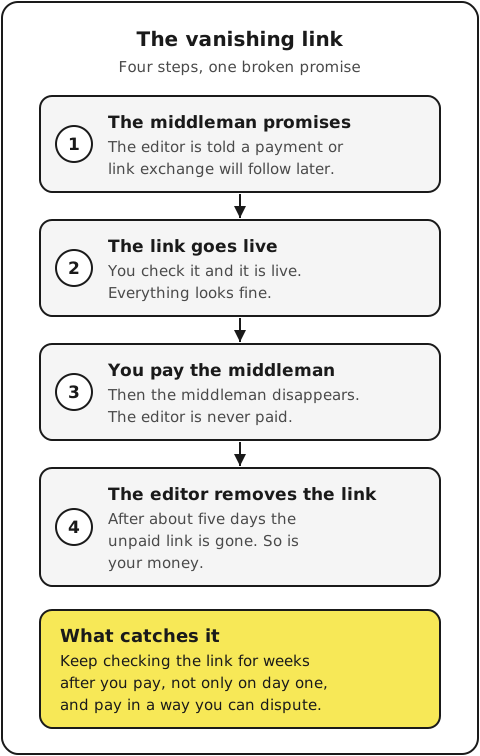
This pattern is nastier because everything looks fine at first. A middleman agrees with the site's editor that a payment or a link exchange will follow later. The link goes up. You check it, it's live, and you pay the middleman.
Then the middleman disappears. The editor never gets what they were promised, so after about five days they remove the link and move on. You've lost your money, and the person you paid is gone.
The site was real and the link was real. The fake part was the promise the middleman made to the editor. A one-time check on the day the link goes live doesn't catch this, so keep checking for weeks after you pay, and pay in a way you can dispute (see the payment section below).
A live link proves a link exists, not that the seller can place yours
Sellers often send "proof": a list of live links they say they placed. A live link only proves that a link exists. It doesn't prove the seller placed it, or that they can place another.
Some proof lists include pages that redirect somewhere else, return server errors, or sit on hacked sections of real sites, sometimes on .edu domains. Open every URL yourself. Check that the page loads, that it's indexed, and that the link is in the page itself, not only in a tool report.
Useful proof is a recent placement on the same site, in a similar article, that you can open today.
"Permanent links" and guaranteed rankings are sales lines, not terms
"Permanent link guaranteed" sounds like a term. It isn't one. No seller controls a publisher's site forever: pages get deleted, sites get redesigned, and editors clean up old posts.
Instead of "permanent", ask in writing what happens if the link is removed, and within what period. A clear answer, even a limited one, is worth more than "forever". Screenshot that answer.
Guaranteed rankings are the same kind of line. No seller controls how search engines rank your page. A ranking promise tells you about the seller's sales script, not about the link.
In a link exchange, add your side only after theirs is live
Link exchanges have their own stall. The other side asks you to add their link first. Then they keep delaying yours, and after a few weeks they tell you it didn't work out. By then their link is live on your site, and yours never existed.
The fix is the order of steps. Wait until their link is live, check it yourself, then add yours. Keep monitoring both links, because a link that goes live can also quietly disappear.
Fake sites look like real blogs but exist only to sell links
The second kind is a site that looks like a real blog but exists only to sell links. For a buyer, white hat is mostly about this: the kind of site your link sits on, and whether there's a real business behind it.
Lookalike outlets sell a famous name the real publisher never offered
Some sellers offer a placement in a famous outlet that turns out to be something else. It may be a country edition that doesn't exist. It may be a domain one letter or one ending away from the real one, like a .net where the real outlet is a .com.
The tell is a famous name at an ordinary price, with the exact URL held back until after you pay. The check takes two minutes. Start from the publisher's own main domain, not from a link the seller sends, and find the edition there. Then compare the domain in the offer letter by letter, including the ending.
Link farms and blog networks dress up as real blogs with a "write for us" page
Link farms rarely look like farms. They publish articles on every topic, from crypto to dog food to injury lawyers, each with one or two paid links. They usually have a "write for us" page, a price list, and no product, service or audience of their own.
Blog networks go one step further. One owner runs many sites that look independent, often with different designs and author names, and sells links across all of them. A link from one of them looks like a link from a blog. It's a link from a seller.
You do get a link from these sites, so the scam isn't the delivery. The scam is selling them as real blogs with real readers.
Three checks expose a link-selling blog: how it earns, what else it links to, whether its older posts are still indexed
- How it earns. Look for a product, a service or a real audience. If the only visible income is "write for us" and paid posts, treat the site as a link seller.
- What else it links to. Open a few recent posts and look at the outbound links. Casinos, supplements and payday loans on a blog about project management mean the site sells to anyone.
- Whether older posts are still indexed. Search for a few older articles by their titles. If the archive is missing while fresh paid posts appear every week, the site publishes for sellers, not for readers.
These are the checks for spotting a link seller. For the full list of what I look at on any site before paying, see what to verify before outsourcing link building.
A link from a real business still matters if the site's search traffic went to zero
Here's the test I use for any site. Would a link from that site still matter if its search traffic went to zero?
A SaaS company gets traffic from many places besides search: its email list, social followings, brand searches, direct visits and customers who log in every day. Content is just one of its acquisition channels. A link there sits in front of real people for reasons that have nothing to do with you.
A link farm has nothing left when search traffic goes, because the link was the product.
Fake numbers make a weak site look strong
The third kind doesn't fake the site. It fakes the numbers that make you trust it.
A high DR with no readers and no business means the number is the product
DR and similar scores measure links, not readers or revenue. They can be built. A site can buy or swap enough links to push its score up, then sell links on the strength of that score.
Two patterns give it away. One is a sudden jump in referring domains, for example from a few hundred to a few thousand in a short time. The other is a huge backlink count with very few links from sites you'd recognise.
When a high DR comes with thin articles, no product and no sign of readers, the number is what the site sells. Treat it as a warning, not a bargain.
A seller's traffic screenshot is the seller's evidence, so check traffic under your own login
Some link-selling sites run on copied content and bot traffic, sold with a screenshot of the traffic chart. The chart can be real and still say nothing about readers. A screenshot is the seller's evidence, not yours.
Check traffic in your own SEO tools, under your own login. Compare the trend, the countries the traffic comes from and the referring domains with what the seller sent. If you sell to English-speaking markets, a site with most of its traffic somewhere else won't send you buyers.
A rebuilt expired domain keeps the old metrics but not the business that earned them
Expired domains are another source of borrowed numbers. Someone buys a domain that used to belong to a real business, puts up a blog and sells links on it. The old backlinks and the old DR stay. The business that earned them is gone.
Check the domain's history in a web archive and in your SEO tools. Look for a change of owner, topic or language, or a gap when the site was offline. When that change comes with content that mainly hosts paid links, the DR describes a site that no longer exists.
Fake paperwork targets your payments after a real order
The fourth kind never touches the placement. It arrives after a real order, when your contacts and payment habits are known, and it goes after whoever pays the bills.
A "you didn't pay" invoice arrives for a placement you already paid for
After a real paid placement, a message arrives from someone posing as the site's webmaster. It says the link is unpaid, asks for payment or proof of payment within a day or two, and threatens to remove the link. Sometimes it bills you for a placement that you, or your agency, already paid for.
The tell is an invoice that nobody on your side can match to an order, plus a deadline designed to make you panic. The finance rule that stops it: every payment needs an approved order note and a matching order record. An invoice with no order note waits until the person who ordered confirms it through a contact they already have, not through anything in the message.
Scam, overpromise or normal failure: the seller's behaviour tells them apart
Not every failed order is a scam. Publishers reject pages, editors leave, sites change their rules and links get removed for reasons a legitimate seller can't control. Judge the seller by what they claimed, what they could verify, and how they act when the order fails.
This matters because each one needs a different response. Fraud needs a dispute. Overpromising needs a firm deadline. An honest failure needs patience and the agreed remedy.
Fraud is when the seller knowingly lies about access, proof, delivery or terms
Fraud means the seller knew. They sell a placement they don't have, show proof they didn't produce, or promise a delivery they never planned.
The stall tactic belongs here. Selling a placement you know you can't deliver, then presenting the failure as a production problem, is fraud dressed up as an operational problem. The middleman who takes your money and leaves the editor unpaid belongs here too: the link was real for a few days, but the deal behind it never was.
Overpromising is when the seller says yes first and looks for a route later
The overpromising seller isn't trying to steal. They take the order and then look for a route. The deadline keeps moving because there was no confirmed route when they said yes.
You may get your money back in the end. You still lose the weeks your budget sat with someone else. A rejection date agreed up front tells you much sooner.
Operational failure is when real access stops working
Sometimes the access was real and something changed. The editor left, the publisher stopped accepting insertions, the page was deleted or the site changed its rules. A trustworthy seller explains what changed, rejects the order promptly and follows the agreed refund or alternative.
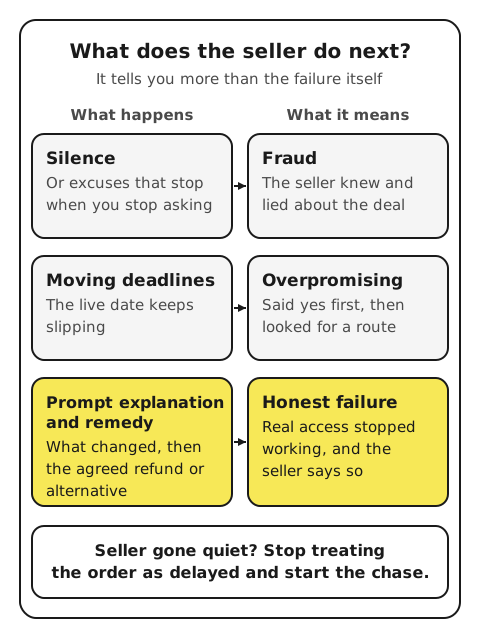
Fraud ends in silence, overpromising in moving deadlines, honest failure in a prompt remedy
What the seller does next tells you more than the failure itself.
- Fraud ends in silence, or in excuses that stop when you stop asking.
- Overpromising ends in moving deadlines.
- An honest failure ends with a prompt explanation and the remedy you agreed.
If the seller goes quiet, stop treating the order as delayed. Start the three-step chase in the payment section below.
Three things in writing before you pay settle most disputes
One short note, agreed before payment, settles most disputes before they start. It also gives the order owner something concrete to chase with, and it's the evidence you'll need if you open a dispute.
The placement: the exact article, sentence, target URL and anchor
Name the live article URL, not just the domain. Add the sentence where your link goes, the target URL on your site and the anchor text. When you buy backlinks as link insertions, the article already exists, so a seller who can't name it hasn't confirmed the placement.
The timeline: a live date and a separate date when the order counts as rejected
Delivery time and rejection time are not the same thing. "The editor is busy" can be true for a week. Set a live date and, separately, the date when the order counts as rejected, so nobody argues about it later.
The remedy: a refund, a replacement, or nothing after a stated period, written down
Agree what happens if the link never goes live, and what happens if it's removed later. "Nothing after a stated period" is a valid answer if it's written down. A seller who won't state any remedy has told you what to expect.
Here's the whole note. Paste it into the email or chat where you place the order, get a "yes" to it before you pay, and screenshot that "yes".
Article: [exact article URL]
Sentence: [where the link goes]
Target URL: [your page] / Anchor: [anchor text]
Live by: [date]
Rejected if not live by: [date]
If not live: [refund / replacement]
If removed within [period]: [refund / replacement / none]
Payment: [method], [amount], due when [condition]
Buying links as a team means one owner for every prepaid order
Scams succeed when nobody owns the checks. That's an organisation problem more than a link problem, and it's cheap to fix.
In-house teams need one approver, one shared record per link and one rejection rule
One person approves every order, so claims about access get questioned the same way each time. Keep one shared record per link with the order note, the payment record, the seller's messages and screenshots of every guarantee they gave. Add a screenshot of the live link when it goes up, and note each later check that it's still there. One rejection rule applies to every order, so the timeline doesn't change from seller to seller.
What to check on the site itself before anyone approves an order is a topic of its own, and the three checks for a link-selling blog above are the place to start.
Finance pays only against an approved order note
This one rule stops the fake invoice. An invoice without a matching note goes back to the approver instead of into the payment run. It also means every payment has a named owner if the order stalls.
Agencies buy links that sit on a client's site, so keep proof per client
Agency link builders carry an extra layer of risk. The link sits on the client's site, and the client lives with it long after the campaign report. Keep each client's orders, proof and terms separately, so you can show exactly what was bought, from whom and on what terms.
Proof per client also protects you when a link vanishes. If a middleman's link disappears after a week, you can show the client what was agreed and what you did about it.
Link pickers judge the article and the sentence, not just the domain
If you hand-pick every link, read the article your link will sit in. Check that the sentence still reads naturally with your link in it. If the sentence has to be bent to fit, a strong domain won't fix it.
A low price alone doesn't prove fraud, and a high one doesn't prove quality. The cost of a wrong pick is real either way, because you pay for the link whether or not it was worth having.
Pay in a way you can dispute, screenshot every promise, and chase a stalled order in three steps
How you pay decides what you can do when an order goes wrong. Decide it before the order, not after.
Hard-to-reverse payments are a risk factor, not proof of fraud
Payment methods with a buyer dispute process give you a route back if an order is never delivered. Bank transfers and crypto are usually much harder to reverse. A seller who insists on them isn't automatically committing fraud, but count it as a risk factor.
PayPal gives you 180 days to dispute an order that never arrives, and a long stall can use most of it
When a seller gives you a choice, I pick the option with buyer protection:
"If there's a choice between Wise, Payoneer and PayPal, I'd go with PayPal, because of the protection it gives you."
PayPal's own help pages say a dispute for an item not received must be opened within 180 days of the date you sent the payment. If you received something that isn't what you agreed, the window is 30 days from delivery or 180 days from payment, whichever comes first. A dispute closes after 20 days unless you escalate it to a claim.
Purchase protection comes with eligibility terms, so check PayPal's current terms for service payments in your country before you rely on it. This is also why the stall is dangerous: a seller who asks for "a few months" is quietly using up your dispute window. This is not legal advice.
Screenshots of every guarantee, and regular checks that the link is live, are your evidence
A dispute is only as strong as your evidence. Screenshot every guarantee the seller makes, in email, chat or on their sales page, because chats get deleted and pages get edited. Keep the screenshots with the order note and payment record.
Track everything yourself rather than relying on the seller's report. Keep checking that each link is still live after it goes up, not only on the first day. The middleman pattern shows why: a link that vanishes after five days is only a case you can make if you noticed in time.
A stalled order gets the written order back, one final date, then the agreed remedy
When an order passes its rejection date, act in this order:
- Send the written order back to the seller, with the agreed dates.
- Set one final response date and state what happens when it passes.
- Use the agreed refund or dispute process, with the order note, screenshots, messages, invoices and payment records attached.
Don't add new deadlines after step two. Every extension is time the seller gets and you lose, and part of your dispute window goes with it.
Approving the exact site, article and sentence before you pay removes most of these scams
LinkVendors is my company, so I've kept this section short and aimed to keep it fair. It's a link insertion marketplace with 1,000+ sites of established software companies that earn from their product, not from selling links. Each one is a real brand with several traffic sources, so it passes the traffic-went-to-zero test above.
You search published articles by keyword and add the page you want links to. An AI check then leaves out pages and sites that compete with you. Each result shows the article and the sentence where your link would go. You approve the exact site, article and sentence before you buy.
Approving at the article and sentence level, not just the domain, is the main difference from hiring a link building agency.
You pay upfront and get a refund if the link doesn't go live. Prices start from $250 per link and depend on the site. I compare it with other options in link building services and marketplaces.
To see what this looks like for your own keyword, search by keyword on LinkVendors.
Two answers decide whether to pay any seller
Every scam in this article fails against two answers. Ask them about any seller, including us.
- Can you see and approve the exact page before you pay? If the seller can't name the domain, the article and the sentence, you're paying for a promise. That's where the stall, lookalike outlets and fake access live.
- Would the site still matter if its search traffic went to zero? If not, the link was the product. That's where link farms, blog networks, fake numbers and rebuilt domains live.
If both answers are yes, write the order note, give the order an owner, pay in a way you can dispute and keep checking the link after it goes live. If either answer is no, don't pay.
When you're ready, find the article and sentence for your next link on LinkVendors.