How to Buy Backlinks for a SaaS Company: Choose Real Business Sites, Approve the Placement, Check the Live Link
 November 10, 2026

Search "buy backlinks" and you'll find bulk link packages, PBN bundles, link blasts, and "grey niches welcome" sites that will happily link to payday loans, essay writing services and replica watches. Most of it is written for affiliates, agencies and people who buy links by the spreadsheet row.
If you work at a software company and you've just been given a budget to buy links for the first time, that's not what you're after. You might be an SEO, a growth person or even a founder doing it on the side. You want links from real businesses, placed where a customer might actually read them.
Most guides on buying links judge sites by numbers: DR above a line, traffic above a line, spam score below a line. This guide starts somewhere else. When you buy a link, you're buying one sentence on one page, and that changes how you choose sites, how you order and how you check the result.
I've been building links for more than ten years. I co-founded GetFoundXL, and since 2023 I've run ClickCrab, a link building agency. Here you'll get a site test for real businesses, the red flags I look for, what a good placement looks like, an order you can send to any seller, and a way to check the live link. I'll also tell you how long links really take and the most common reason one doesn't go live.
White hat here means two plain things: the kind of sites you buy on, and a process where you approve the placement before you pay.
When you buy a link, you're buying one sentence on one page, so judge the page and not the domain
Most link offers are sold by domain. You see a DR, a traffic number and a price, and someone picks the page later. But what you pay for is a sentence in a specific article on a specific site.
That sentence is what a reader sees. It decides whether the link fits the topic, whether the page can pass any value, and whether the editor keeps it. A strong domain with the wrong article is still a wasted link.
This matters more when the budget is new and every link is a line item someone will ask about. I said this once about link building as a job, and it applies to buying just as well:
"[I]f you're building links, every decision you make is attached to actual spend. Do I build this link or not? Do I buy this link or not? [...] do I exchange this or not? So everything has [...] value, and a series of mistakes can cost money"
So every check in this guide happens at page level. Domain metrics help you build a shortlist. The page, the sentence and your target page decide whether you buy.
The four ways to buy links give you different control over where the link lands
Before you spend anything, know which route you're on. Each one answers two questions differently: who chooses the site, and what you see before you pay.
| Route | Who chooses the site | What you see before you pay |
|---|---|---|
| Link building agency | Usually the agency, from requirements you agree; some send a few domains at a time for you to approve | The agreed requirements and the price, or a small slice of their sites |
| Big link marketplace | You, from 100K to 1M listed sites | Usually a domain and its metrics; some offer page-level search |
| Doing outreach yourself | You, and whoever replies | Whatever the editor agrees to |
| Marketplace of software company sites | You, from the full searchable inventory | The article, the sentence, DR, traffic and price |
Agencies charge per link and usually choose the sites for you
An agency is the classic first move. You agree a price per link, hand over your target pages and wait. Many agencies work from agreed requirements and don't let you approve sites before buying.
Other agencies do let you approve each domain, but they usually show you a small slice of their sites at a time, not their whole inventory the way a marketplace does.
Agencies also sell link packages, and with those you can't really select the links. Cheaper packages sometimes let you filter by metrics, but they tend to use sites the agency has bulk deals with and resells to many clients, or sites with inflated metrics. If you go the agency route, write your requirements down before they start and read what to verify before outsourcing link building.
Big marketplaces list 100K to 1M sites, and most of them exist only to sell links
Big link marketplaces brag about their size. Yet most of the sites in them exist only to sell links. You can filter by DR and traffic, but filters don't tell you whether a site is a business or a link farm with a nice theme.
For a SaaS buyer who wants only real businesses, most of that catalogue is noise. Some of these marketplaces let you search at page level, which helps. But the vetting is still on you, site by site.
Doing outreach yourself now costs weeks of emails for placements that are already on sale
You can email site owners yourself, or trade links through SaaS link exchanges. Exchanges need someone in-house with access to your content and sites of your own to trade. Outreach needs weeks of emails, and reply rates keep dropping as more people mass-email with AI.
Outreach still makes sense for relationships you want to keep and for digital PR. But if the goal is a placement on a site that already sells them, you're spending weeks to reach a seller who is already listed somewhere.
A marketplace of real software company sites shows you the whole inventory down to the sentence
Since LinkVendors is my company, it falls in this group, and I've aimed to keep this section fair. Against agencies, the difference is that you see the full inventory and search it yourself, and you approve the article and the sentence, not just the domain. Against other marketplaces, page-level search isn't unique to us. What changes is where you start: every site belongs to a software company that earns from its product, so you aren't filtering real businesses out of a list built for link sellers.
My view is that for most SaaS teams, the best starting point is someone in-house plus a marketplace. The in-house person owns the target pages and the judgement calls. The marketplace saves them the weeks of finding sites. If you're weighing this against hiring a service, see link building services vs marketplaces.
Choose sites run by real businesses that earn from a product
Here's the test I use: would a link from this site still matter if its traffic from Google went to zero? The checks below tell you whether a site is that kind of business. Run them in order. Most of them raise flags rather than give a yes or no, so look at all of them before you decide.
The site earns from a product, not from selling links
Open the homepage, not the blog. A real software company has a product page, pricing, a login or sign-up button, docs or a help centre. The blog is just one of its acquisition channels.
A link-selling site turns that around. The blog is the whole site, the "products" are affiliate links, and the contact page is about advertising. If you can't tell what the company sells within a minute, skip it.
Then look for other signs of a business: a brand people search for, social accounts that talk about the product, a newsletter. One weak signal is fine. No signals at all means the site exists to sell links.
Who the site links to tells you who else has paid to be there
Open three or four recent articles and look at the links inside the body text. On a real company site, most outbound links point to sources, tools and partners that fit the topic. Links to grey-niche sites are a bad sign.
Look at the anchors too. Commercial anchors to unrelated sites in post after post mean the site sells to anyone, and your link will sit next to theirs. Sitewide links in the homepage footer or sidebar are not a good sign either.
A backlink tool's outgoing links report shows the same pattern across the whole site. If grey niches show up, I don't buy, whatever the DR.
DR, traffic and the other metrics are red flags, not hard filters
DR and organic traffic are useful for a shortlist. But they're models, so take them with a grain of salt. I treat every metric as a red flag to look into, not a hard filter that decides for me.
These are the flags I look at before paying:
- DR and traffic out of sync. A DR 88 site with about 1,000 visits a month makes no sense. A big brand with neglected SEO can look like that, but it's rare.
- Traffic value far too low for the traffic shown.
- One article doing all the ranking, with the rest of the site getting almost nothing.
- Far more outbound linked domains than referring domains. A site that links out to tens of thousands of domains passes less value per link. A site that blocks the Ahrefs crawler so you can't see this is a flag in itself.
- A traffic drop of 50% or more in the last six months. LinkVendors lets you skip sites whose organic traffic fell 50% or more in the last 6 months.
- Too many or very aggressive ads.
One flag doesn't kill a site. If a domain is very strong and relevant, it can still be worth it for branding or AI search visibility.
A site whose editor sees you as a competitor won't publish your link
If a site sells a product like yours, skip it, however good the article looks. Its page competes with yours for the same searches. This is also the most common reason a link doesn't go live: the editor sees you as a competitor, commercially or in search.
On LinkVendors, you add the page you want links to, and an AI check leaves out sites that compete with you. Still, look at the shortlist yourself before you pay.
The audience should match the market you sell to
A link should put you in front of people who could become customers. If you sell to marketing teams in the US, a site read mostly by developers in another language market is a weak fit, even with good numbers.
Check the country split of the site's traffic and the topics of its recent posts. I prefer sites with the US as the top country, but top country is a flag, not a rule. Ahrefs itself at one point had India as its top traffic country, and a hard country filter would have thrown out a link that many buyers in the SEO space would want.
So decide based on your goals before you pay. All LinkVendors sites are in English, and most of their traffic comes from English-speaking countries. If your market is elsewhere, look for sites that fit it.
A good placement is a relevant sentence in an article that already ranks
Once the site passes, look at the page. A good placement has three parts: an article on a topic close to your target page, a sentence where your link makes sense, and a target page that delivers what the sentence promises. For a real before/after example, see what a link insertion is.
Link insertions put your link on a page that's already indexed and often ranks for multiple keywords
A link insertion is a link added to an article that is already published. Nobody writes a new guest post. The page is already indexed and often already ranks for multiple keywords.
For a first-time buyer, that's the big advantage. You can see the page before you buy: its rankings, its traffic and the exact sentence. You're buying something that exists, not a promise.
Guest posts are a different purchase with different prices, so compare them separately
A guest post is a new article written for the site, with your link inside. You can't see the final page before you buy, and a new page starts with no rankings. It's a different product, and it's priced differently.
Keep the two apart when you budget. A price range that mixes guest posts and insertions tells you nothing about either. Compare insertions with insertions and guest posts with guest posts, as covered in guest post vs link insertion.
The sentence should read naturally whether or not your link is in it
Read the sentence with the link and without it. If the sentence only exists to hold your link, editors and readers will notice. If it reads the same either way and your page adds something, it's a good fit.
Good insertions often link words that are already there, like a product category or a task the reader wants to do. When no sentence fits, one new sentence can work. It should add a fact or a step the article was missing.
Pick the target page first, then the anchor that fits the sentence
Start from the page you want to rank. Pick one that makes you money and already deserves the click: a feature page, a use-case page or a strong guide.
Then choose the anchor from the words in the sentence. The anchor should describe what the reader gets on your page. Forcing your money keyword into a sentence where it doesn't fit makes the link stand out, and editors are likely to push back.
Skip pages where your keyword already links to someone else
If the article already links your keyword to another site, your link has to share that phrase or replace it. Replacing it means asking the editor to remove someone else's link. Two links on one phrase look odd to readers.
Find a different sentence on the page, or a different page. LinkVendors' AI check leaves these pages out of your results, along with dead pages.
Set up the order so nothing is left to the seller's judgement
The order is where you can lose control. A vague order lets the seller choose the page, the sentence and the anchor for you. A precise one leaves them only the job of placing it.
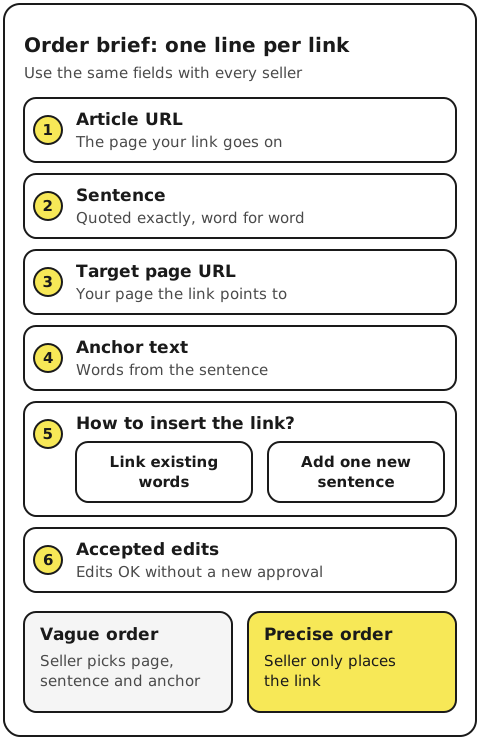
Give the seller the article, the sentence, the target page and the anchor
Send one line per link with:
- the article URL
- the sentence, quoted exactly
- the target page URL
- the anchor text
- whether to link existing words or add a new sentence
- which edits you'll accept without a new approval
If you work with more than one seller, use the same format for all of them. It makes orders easy to compare and easy to check later.
Ask to link words already in the article or to add one new sentence
These are the two ways an insertion can go. Linking existing words changes the least on the page, so it's the cleanest option when the sentence already says what your page covers. Adding a sentence works when the article covers the topic but no sentence fits your page.
If you ask for a new sentence, say what it should add. Give the editor the fact or the step, not a paragraph of marketing. Publishers have the final say on wording, so expect light edits and decide in advance which ones you'll accept.
Agree on payment, refund and delivery terms before you pay
Know three things before you pay: when you pay, what happens if the link doesn't go live, and how long it should take. Get them in writing. Written terms also make it easier to spot a seller who takes the money and stalls.
On LinkVendors, you pay the full amount upfront by card, and you get a refund if a link doesn't go live. We place links through the editors and link builders who already work with these sites. We don't own or control these sites, and publishers have the final say.
We list up to 45 days, but that's us staying on the safe side, not the norm. You usually know within about two weeks whether a deal will happen, and many links go live by about 30 days.
Check the live link against what you approved
When the link goes live, you get the article URL. Check it the same day, while the order is fresh.
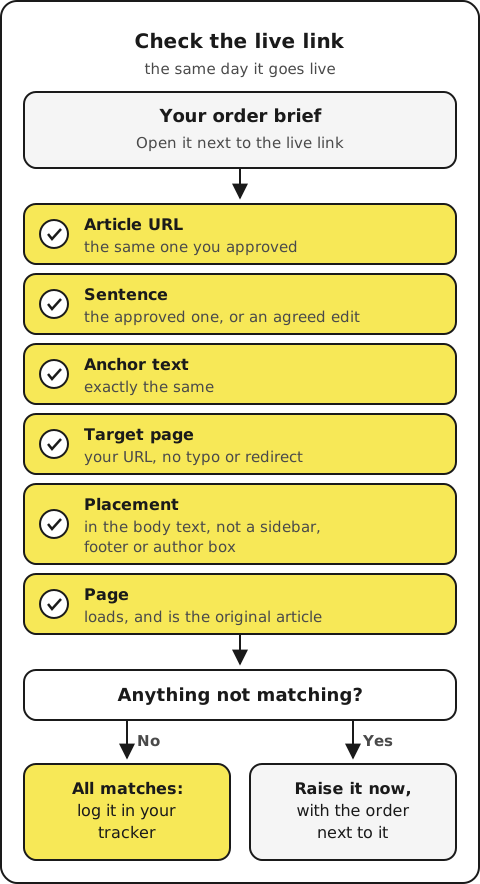
The live link should match the order line by line
Check that:
- it's the same article URL you approved
- the sentence is the one you approved, or an edit you agreed to
- the anchor text is the same
- the target page is the same URL you sent, with no typo or redirect
- the link sits in the body text, not in a sidebar, footer or author box
- the page loads and is the original article, not a new page made for your link
If anything doesn't match, raise it right away with the order next to it. It's easier to fix in the first days than months later.
Recheck the link a few weeks later and again a few months later
Links can disappear. Articles get updated, rewritten or merged, and a link can go with them. A recheck after a few weeks catches quick removals, and one after a few months catches content updates.
Keep a simple tracker: article URL, target page, anchor, live date and recheck dates. A spreadsheet is enough. Also check that the article still gets traffic, since a link on a page that dropped out of search is worth less than when you bought it.
Judge results by the target page's rankings, not by the link count
Link count is easy to report and says little. What matters is whether the target page moves for its keywords.
Note the target page's rankings for its main keywords before the first link, then check monthly. Compare it with similar pages you didn't build links to.
If a page doesn't move after a few links, look at the page itself before buying more. Links help a good page rank. They don't fix a page that doesn't answer the search.
Spend per link based on the site and start with the pages that make you money
Prices vary a lot by type of link, so here I'm talking about link insertions only. In my experience buying link insertions, the low end is about $50 for a link on a plain blog, sometimes less. You get what you pay for:
"Cheap insertions on plain blogs are a ticking time bomb. A Google update hits, the site gets a penalty or gets caught selling links, its traffic goes to zero, and nobody cares about that site anymore."
At the high end, again in my experience, an insertion in a good article that ranks and gets traffic, on a site with strong metrics, can cost up to about $1,000. On LinkVendors, links start from $250 and the price depends on the site. We moved away from cheap blogs for exactly the reason in that quote.
Don't start with a package. Start with a few links to your priority pages: the ones closest to revenue, already good, and already ranking somewhere near the top. Learn from those before you scale.
Keep guest post and insertion prices in separate columns when you compare. And compare more than one seller: the same site can show up in more than one place, so compare the exact site and placement type before you order.
LinkVendors lists only sites of established software companies, and it isn't for every buyer
Since LinkVendors is my company, it's in this guide, and I've aimed to keep it fair. LinkVendors is a link insertion marketplace of 1,000+ sites of established software companies that earn from their product, not from selling links.
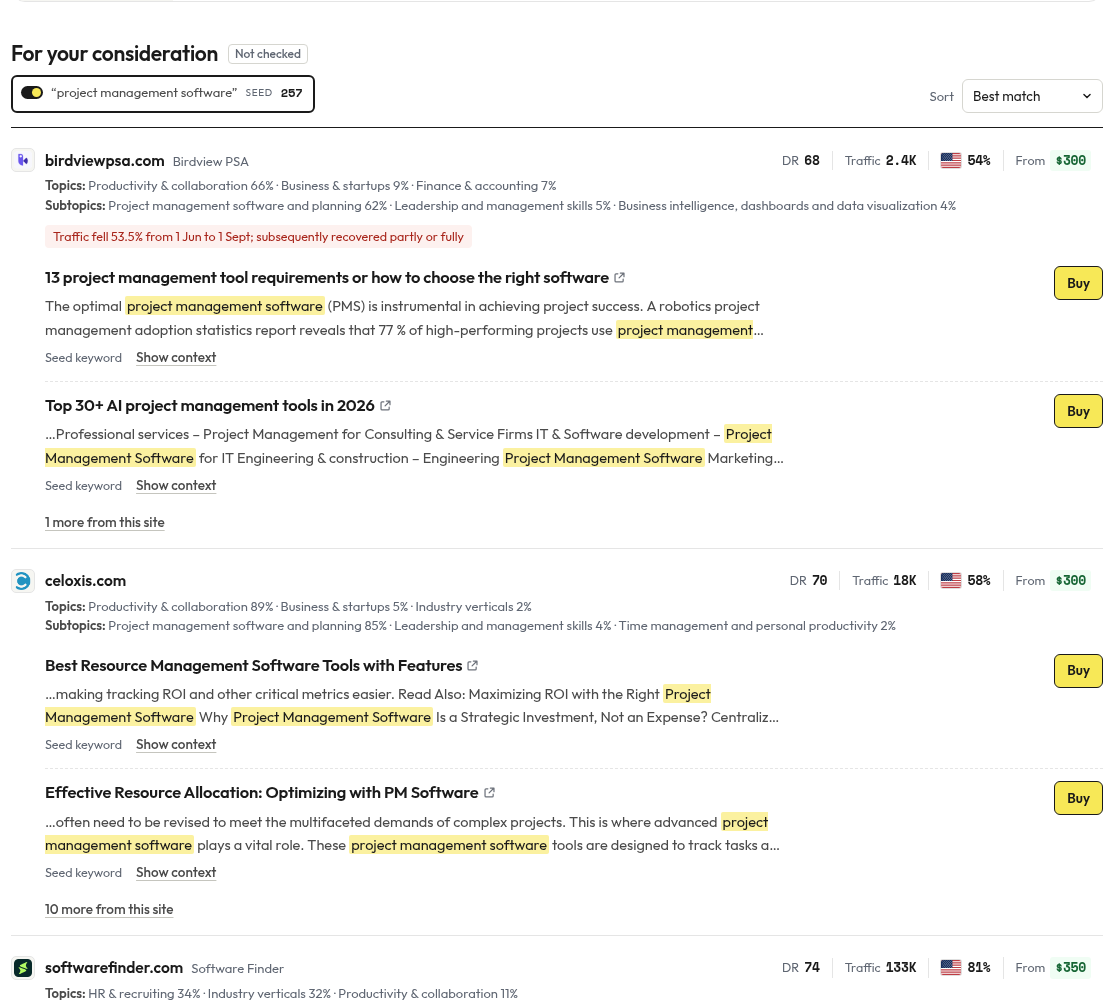
You search by keyword across 1M+ published articles and add the page you want links to, so sites that compete with you are left out. Each result shows the article, the sentence with your keyword, the site's DR and traffic, and the price.
You approve the article and the sentence, pay upfront by card and get a refund if the link doesn't go live. Prices start from $250 per link and depend on the site. For how it compares with other marketplaces, see the best link building marketplaces for link insertions.
LinkVendors is not for you if you're outside SaaS, ecommerce or tech, or if your priority is links on grey-niche sites. And if you need something truly unique, that's digital PR, which is a different job from link building.
If you're a SaaS team that wants links only from real software companies, search by keyword on LinkVendors and see which sites already have an article where your link fits.
Two questions decide every link you buy
First: does this site earn from a product, or from selling links? If it's a real business with a product and a brand, it's worth a closer look. If its only income is selling links, skip it.
Second: would you approve this exact sentence if a customer read it? If the sentence helps the reader and your page delivers on it, buy. If you'd be uncomfortable with a customer finding it, don't.
If a link passes both, the only question left is price. Start by searching by keyword on LinkVendors, with the page you most want to rank as your page to promote.