Guest post vs link insertion: what you can check before you pay decides which one to buy
 November 10, 2026

A guest post order is a bet on a page that doesn't exist yet. You pay for a spot on a "tech and business" blog, brief a writer on your product, approve a draft about workflow automation and wait. Only after that do you see whether the live URL sits between "10 best payday loan apps" and a review of vape juice flavours.
The link is live and the invoice is paid. Nobody on your team would have picked that page if they'd seen it first.
This article is for the person who signs off link spend for a SaaS site: an SEO, a growth person or even a founder. You're probably here because you have a budget for this month and need to choose between buying guest posts and buying link insertions. The articles that rank for this, and the AI summary above them, mostly compare the two as formats and tell you to use a mix. A couple of them also tell you to look at the page before you order.
I take that further and compare the two on what you can actually check before you pay. I also show where a link insertion stops being an insertion. I've spent more than ten years building links, and at GetFoundXL and ClickCrab I hired link builders to do both guest posts and link insertions. I also run LinkVendors, a link insertion marketplace, so I have a bias, and I say plainly when a guest post is the better buy.
My position: for most SaaS link teams, link insertions on real software company sites should be the default. Guest posts win in a few clear cases. In both formats, the site matters more than the format.
The real difference is how much you can check before you pay
With a guest post, you pay for a page that doesn't exist yet. You see a domain and maybe agree on a topic. The page, its place on the site and what it will do for you only show up after the money is gone.
With a link insertion, the page already exists. You can open the exact article before you order. You can see how old it is, how much traffic it gets, which keywords it ranks for and which sentence your link would sit in.
That gap matters because every link is a spending decision, and a run of bad picks costs real money. The more you can see before you pay, the fewer of those mistakes you make. That's the frame for everything below.
Guest posts and link insertions compared on six buyer criteria
| Criterion | Guest post | Link insertion | Verdict |
|---|---|---|---|
| Page history | A new URL with no traffic, rankings or links yet. You can't check it before you pay. | An existing page. Already indexed and often already ranks for multiple keywords. You can check it first. | Insertion |
| Cost structure | One price for writing, editing and placement. Setproduct, a vendor, lists guest posts starting at $200. Plus your team's time on briefs and approvals. | Placement on a page that already exists. Setproduct lists niche edits at $50 to $400. On LinkVendors, from $250 per link, depending on the site. | Compare cost per live link, not price per order |
| Time to live | More steps: pitch, topic approval, writing, edits, publishing. Setproduct lists 2 to 6 weeks. | Fewer steps: a link or one sentence added to an existing article. Still depends on the editor. | Insertion has fewer steps, not a promise of speed |
| Control over context | You write the words. The host still edits and decides where the post sits. | You pick the article and sentence. You work with the text that's already there. | Guest post for the words, insertion for the choice |
| Link farm risk | High on sites that accept guest posts from anyone. | Just as high on sites that exist only to sell links. | Neither format protects you. Check the site |
| Scalability | Each link needs a writer, a brief and an approval round. | Each link needs a target page and an anchor. Limited by relevant articles that already exist. | Insertion |
Guest post prices and link insertion prices sit in separate cells on purpose. They pay for different things, so a blended "average link price" tells you nothing.
A link insertion goes into a page that already has age, indexing and often rankings
With a link insertion, your link goes into an article that is already published. Nobody writes a new guest post. The page is already indexed and often already ranks for multiple keywords.
That's what you inherit: a page with a history you can look at. The advantage isn't that an insertion is magic. It's simpler: you know what you're buying before you pay.
A guest post starts as a new page with no history
A new URL has no traffic, no rankings and no links pointing to it. It may earn them later. It may not.
Sites that publish a lot of guest posts tend to push each new post down the archive quickly. You can't tell how your page will perform, or where it will end up on the site, until after you've paid.
You can check an existing page's traffic and keywords before you order
Before you buy an insertion, look at the actual article, not just the domain:
- Topic fit. Would a reader of this article care about your page?
- Traffic. Does the page get organic visits, or is it dead weight on the site?
- Keywords. What does it rank for, and do those keywords sit near your topic?
- Outbound links. Does it already link out for your keyword, maybe to a competitor?
- The sentence. Is there a natural spot for your link, or would it look forced?
This is a buyer checklist, not a LinkVendors feature. Any real link insertion lets you do it, and some marketplaces offer page-level search too. If a seller won't show you the page before you pay, that tells you something.
Guest post prices and link insertion prices pay for different things
A guest post price bundles content and placement. A link insertion price pays for placement on a page that already exists. Putting them in one range hides what you're actually paying for.
The fair way to compare is cost per live link, including your team's time. Keep the two separate.
Guest post prices include writing, editing and placement
Setproduct, a vendor that sells guest post plans, lists guest posts starting at $200, with 2 to 6 weeks to go live. I found no stated source for those figures on its page, so treat them as one vendor's view. Guest post prices swing with the site and with who writes the article, so always ask what the price includes.
The hidden cost is your team's time. Someone writes the brief, agrees the topic with the host, reviews the draft, asks for edits and checks the live page. Even when the vendor writes the article, someone on your side has to approve it and make sure it doesn't misdescribe your product.
Link insertion prices cover placement in an existing article
Setproduct lists niche edits, its name for link insertions, at $50 to $400. Again, I found no stated source behind the range.
Link insertion prices vary a lot with the site. On LinkVendors, link insertions start from $250 per link and depend on the site.
A low price per link says nothing good about the site behind it. Check the site first, then the price. I cover the risks of buying on price alone in how to buy backlinks.
A guest post has more steps before it goes live
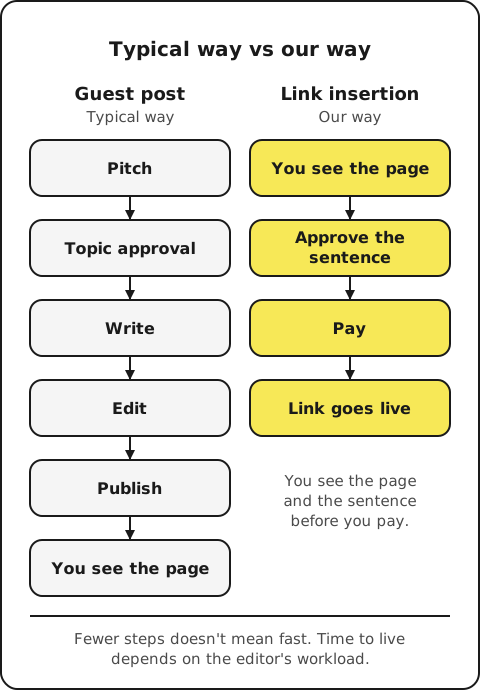
A guest post goes through a pitch, topic approval, writing, edits on your side, edits on the host's side, then publishing. Each step waits on someone. An insertion skips most of that: the editor links existing words, or adds a sentence, in an article that's already live.
Fewer steps doesn't mean fast, though. Time to live depends on the editor's workload far more than on the format. An editor who updates old articles once a month will be slow with any request. On LinkVendors we aim to get links live within 45 days.
A guest post gives you control over the words, an insertion gives you control over the choice
"Control" means two different things here. Buyers often mix them up.
With a guest post you write the article, but the host still edits and places it
You choose the angle, the examples and the words around your link. That's real control, and for some campaigns it's the whole point.
What you don't control is the page itself. The host edits your text, picks the category and decides how it's linked from the rest of the site. You can't see the final page, its traffic or where it sits until after you've paid.
With an insertion you approve the exact article and sentence before buying
With an insertion, you see the article and the sentence with your keyword before you order. Then you give the target page and the anchor text. You can ask for the link on words already in the article, or for a new sentence.
The limit is honest and simple: you work with the context that's already there. If the article is about email marketing and your page is about payroll software, no sentence will make that fit. That's a good limit to have, because it stops forced links before you pay for them.
A link insertion stops at one new sentence
Sellers use "link insertion" loosely, so know where it ends. I count three sizes: the link goes on words already on the page, one to three words are added or edited around the link, or one sentence is added (or a couple of sentences edited). Adding a whole paragraph or block, or adding your company as a new entry in an existing listicle, is something else: a listicle addition, not a link insertion.
A real, public one-sentence insertion, an index.dev article that gained one sentence linking to Adobe Express, is shown before and after in what a link insertion is.
Link farm risk depends on the site, not the format
For a white hat buyer, this is the criterion that matters most. A great format on a bad site is still a bad link. A plain link on a real software company's site is still a good one.
White hat here means the kind of sites and the process: real businesses with a product, several traffic sources, and a buyer who approves before paying.
Sites that accept guest posts from anyone often exist only to sell links
You've probably seen the pattern. A "write for us" page that will take any topic. A blog that covers project management, crypto casinos, essay writing services and keto supplements in the same week. Posts that exist only to carry a link, with no reason for a reader to be there.
These sites will happily publish your guest post on CRM software right next to "best online slots with no deposit". They earn from selling links, so they sell to everyone. Your guest post doesn't change what the site is.
Link insertions on link farms are no better than guest posts on link farms
An insertion is only as good as the site it's on. Big link marketplaces list 100K to 1M sites, and most of them exist only to sell links. Buying an insertion on one of those is the same mistake as buying a guest post there, just with fewer steps.
The check has to happen before payment, on the site, whatever the format.
Link insertions scale more easily for an in-house link team
Each guest post needs a writer, a brief, a topic agreed with the host and an approval round on your side. Picture ten guest posts a month: that's ten small content projects. For a small in-house team, that's a lot of work.
An insertion needs a target page and an anchor. The article already exists, so the work is in choosing the right one. That's why insertions fit a team building links month after month.
The limit: insertions depend on relevant articles already existing. If your category is new, or your topic is very narrow, there may not be enough articles to insert into.
Agencies are the other way teams try to scale. Most agencies charge per link and don't show you their whole inventory the way a marketplace does. On LinkVendors, the full inventory is visible and searchable, and you approve the article and the sentence, not just the domain.
Guest posts win when you need a new asset or no relevant article exists
A guest post is the better buy in these cases:
- No relevant article exists. You've searched the sites you want and nothing covers your topic. A new article is the only way in.
- You want a byline or brand exposure on a specific site. The point is your name and argument on that site, not just the link.
- You need the whole article built around your argument. A framework, a point of view or your own data that needs its own page.
The same goes when what you need would take a whole new paragraph or a listicle spot on an existing page: that's past what an insertion is. And if what you need is truly one of a kind, that's digital PR rather than link building.
Link insertions win when you need links to existing pages on real software brands
An insertion is the better buy in these cases:
- You want links to product, feature or comparison pages. These pages rarely deserve a whole guest post, but they fit naturally into existing articles.
- You want to check the page before paying. Traffic, keywords, the sentence: all visible first.
- You're building links month after month. The workload stays small enough for an in-house team.
For most SaaS link teams, insertions should be the default, with guest posts used to fill gaps. The site still decides everything, so the default only holds on real software brands. More on this in SaaS link building.
LinkVendors sells link insertions on 1,000+ software company sites
Since LinkVendors is my company, I'm describing it here, and I've aimed to keep the comparison fair.
LinkVendors is a link insertion marketplace with 1,000+ established software company sites. Every site belongs to a company that earns from its product, not from selling links. Other marketplaces also let you pick the page, so the difference here is the sites.
You search 1M+ published articles by keyword and see the sentence where your link would go. Add the page you want links to, and an AI check leaves out pages and sites that compete with you. You approve the article and the sentence before buying. We don't sell guest posts.
You pay upfront, and if the link doesn't go live, you get a refund. The full walkthrough is in the best link building marketplaces for link insertions.
To see what's available for your keyword, search by keyword on LinkVendors.
Two checks decide whether you buy a guest post or a link insertion
Run these two checks on any site before you spend.
Check 1: does a relevant article already exist on a site you'd want a link from? If yes, buy the insertion. You can see the page, the traffic and the sentence before you pay. If no, and you still want that site, a guest post is the way in.
Check 2: would that site still matter if its search traffic went to zero? If not, buy neither. The format won't fix the site. I explain why this test works in whether link insertions are still relevant.
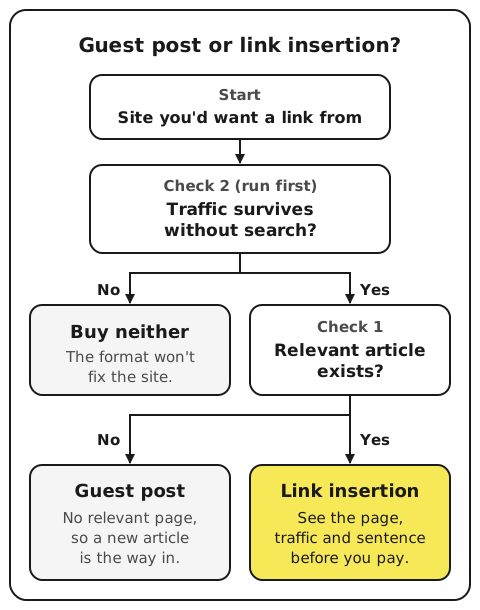
If the answer to both is yes, check whether the article is on one of the 1,000+ software company sites we list. Search by keyword on LinkVendors and look at the exact article and sentence before you order.