Best Link Building Marketplaces for Link Insertions, Judged on the Article You Actually Get
 November 10, 2026

Picture a link insertion listing that shows a domain, a DR, a traffic estimate, a price and a "Buy" button. Only later do you find out where your link went. It might be a fresh guide on CRM pipelines, a 2019 roundup of standing desks, or an article that stopped ranking two updates ago.
That's fine if all you need is a domain on a spreadsheet. It's not fine if you're the one who has to explain the spend.
This is for the person doing the buying. You've already picked link insertions over guest posts. You have a target page, a keyword and a budget, and now you need to choose where to order. If you're still weighing the two formats, start with guest post vs link insertion.
Most "best marketplace" lists rank platforms by catalogue size or DR. Here I judge each marketplace on four checks that only matter for insertions: whether you can pick the article and the sentence, whether the insertion is priced separately, what you see about the host page, and what happens if the link never goes live or disappears later. I also share what I've learned about insertion prices and refunds.
For full feature tours of LinkVendors, Insert.Link, FatGrid and iCopify, read 4 Best Link Building Marketplaces for SaaS. This article only covers how they handle insertions.
Since LinkVendors is my company, it's on this list, and I've aimed to keep the comparison fair.
A link insertion marketplace should sell you a sentence, not a domain
With a guest post, the article doesn't exist yet. You can shape it with the editor before it goes live. With an insertion, the article is already written, indexed and ranking for whatever it ranks for. Your link lands in it as it is.
That changes what you're buying. You're not buying a site. You're buying one sentence on one page, next to the words around it.
When a marketplace only shows you the domain, you pay for a page you never saw. A wrong insertion costs you the link price and the time your target page spent not getting help. So I judge every marketplace in this article on four checks.
An insertion adds a few words or one sentence, never a whole block
Before you compare marketplaces, be clear about what counts as an insertion. I use a simple scale:
- Exact match: the link goes on words already on the page. Nothing is added.
- A few words: one, two or three words are added or edited around the link.
- One sentence: one new sentence is added, or a couple of sentences are edited.
Adding a whole block or paragraph is not an insertion. Neither is adding your company as a new entry in an existing listicle. That's a listicle addition, a different product. Google's AI Overview for "link insertion" counts placements inside listicles and roundups as a type of insertion, so check what a listing actually means before you compare its price with another one.
For a real before-and-after example, see what a link insertion is.
You pick the existing article and the sentence your link goes into
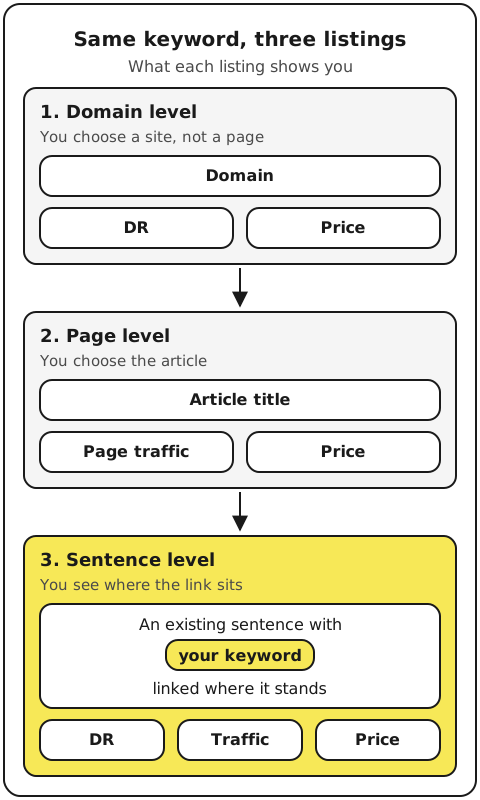
At domain level, you choose a site and the publisher chooses the page. At page level, you choose the article. At sentence level, you also see where in that article your link will sit.
For an insertion, page level is the minimum. The article's topic, its sentences and its rankings are already fixed, so you can judge all of them before you pay. If the platform picks the page after your order, you only learn what you bought when the URL arrives.
What to do with it: before you add money to any marketplace, run one real keyword through its search. If the results are domains and not articles, you're buying blind.
The insertion has its own price, separate from the guest post price
Some listings show one "link" price per site. That number can cover a guest post, an insertion or both, and they aren't the same product. A guest post includes a new article. An insertion goes into an article that already exists and already has its own traffic.
So compare insertion prices only with other insertion prices. If a listing doesn't say which placement type its price covers, ask the platform before you order. If it can't tell you, leave that price out of your comparison.
The platform shows you the host page, not only the domain metrics
The site's DR tells you about the site. It tells you nothing about the page your link goes into. These are the page-level facts worth seeing before you pay for an insertion:
- the sentence your link would sit in, or at least its paragraph
- the page's own traffic and the keywords it ranks for
- whether your keyword already links to another site from that page
- whether the page is still live
If your keyword already links somewhere else on that page, your link has to share those words or use different ones. A dead page is money spent on nothing.
Turnaround, refund and replacement terms are written for insertions
Three things can go wrong with an insertion order. The editor can decline it. The link can never go live. Or it can go live and disappear later, when someone updates the article.
Each needs its own written answer. Find out what happens to your money if the publisher declines or misses the deadline: a refund, or only a balance on the platform. Then find out whether a removed link gets restored or replaced, and for how long. Check the refund page, the terms and the FAQ, not just the listing.
If you can't find a written answer for removed links, assume there isn't one.
The scorecard: four marketplaces on the four insertion checks
Here's how the marketplaces in this article score. I've only marked what each platform states on its own pages, or what we could see on its public pages. Where a platform's pages don't cover part of a check, the cell shows only what they do cover.
| Marketplace | You pick the article and sentence | Insertion priced separately | Host page shown | Insertion terms written down | Verdict |
|---|---|---|---|---|---|
| LinkVendors | Yes: the article and the sentence | Yes: insertions only, from $250 per link | Partly: the sentence, site DR and traffic, price; AI check drops dead pages and pages already linking your keyword; option to skip sites with a 50%+ traffic drop | Partly: refund if the link doesn't go live; 45 days listed as the safe upper limit, with many links live by about 30 days | Built around the sentence; inventory is established software company sites only |
| Insert.Link | Page: yes | Partly: insertions are a separate order type | Yes: page traffic, keywords, DR, referring domains, price | Partly: delivery per the approved order, including publisher and page details; orders not accepted within 7 days are cancelled | A strong page view across many niches |
| FatGrid | Domain: yes | Yes: separate guest post and link insert price columns in Google Search Scanner; link-type filter when browsing | Semrush metrics per result, an AI Keyword Match score and, in Google Search Scanner, the URL that ranks | Partly: full refund to your bank card if it can't get the link published (its claim); alerts if a publisher removes the content or changes link attributes | Price-checking a domain you already chose |
| iCopify | Publisher: yes | Partly: a separate insertion list with a price per listing, but public prices are inconsistent | Traffic, DR, DA, turnaround and price per listing; URLs masked for guests | Partly: escrow; declines and missed deadlines go back to your buyer wallet | Vetting insertion sellers by track record |
None of the four marketplaces scores a clean yes on all four checks. The useful question is which gap you can live with for the link you're buying. If Insert.Link is your current default, see Insert.Link alternatives.
LinkVendors sells insertions only, on established software company sites
This is my company, so weigh this section with that in mind.
Most big marketplaces will happily list sites that take insertions for any grey niche you can name. If you build links for a SaaS company, or you're an agency with legitimate clients outside grey niches, those marketplaces weren't built for you. They were built for other buyers.
"On a 100k-site marketplace, you have to go really hard on the filters, and you'll still get junk."
LinkVendors places your links on 1,000+ sites of software companies that earn from their product, not from selling links. You search across 1M+ published articles on those sites. We only sell insertions, so there's no guest post price to mix up with an insertion price.
Google and AI assistants like ChatGPT trust backlinks from real brands, so your links hold their value through search algorithm changes.
Page-level search isn't unique to us. Other marketplaces, Insert.Link among them, let you choose the page too. The difference is what you're searching: every site is an established software company with its own product and brand. Here's how we do on the four checks.
Search returns the article and the sentence that already contains your keyword
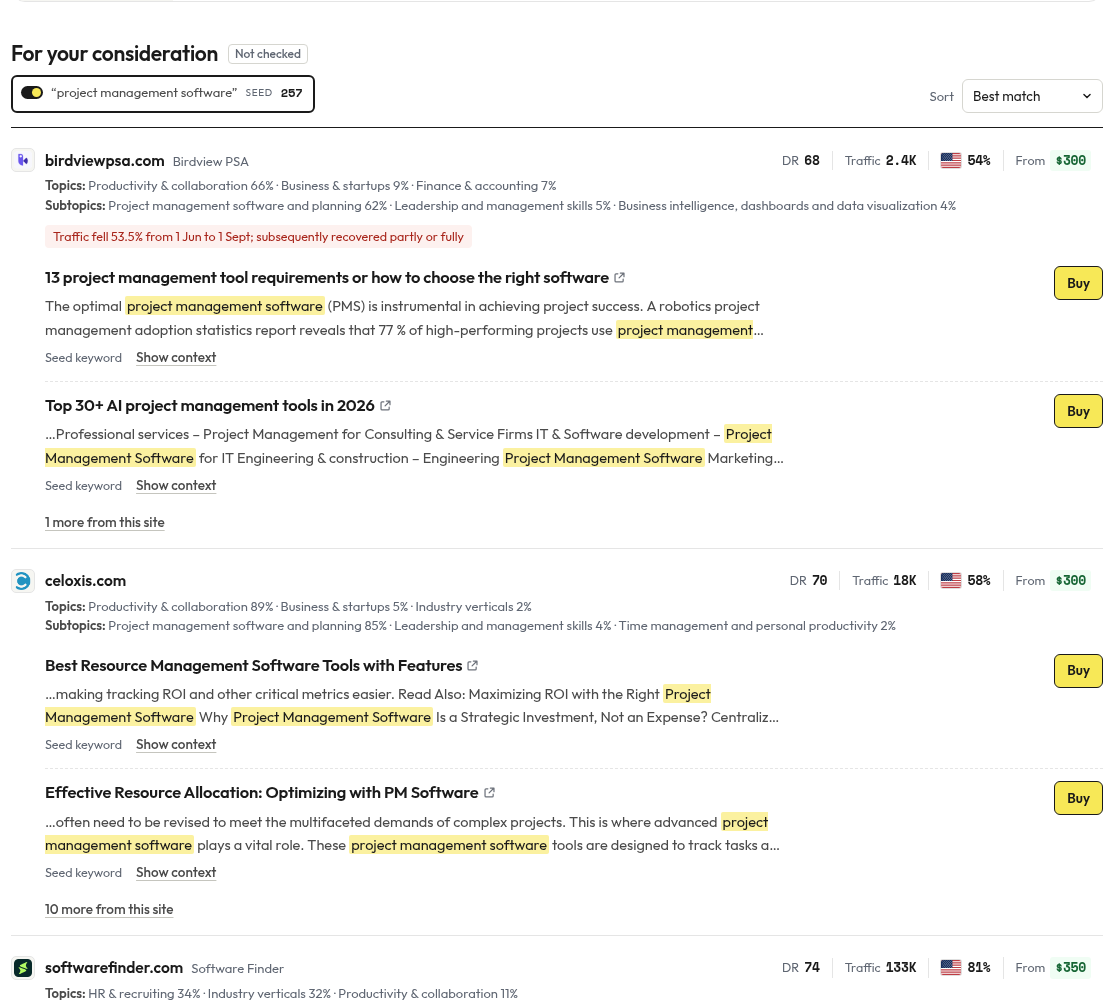
Type a keyword and you get articles, not domains. Add the page you want links to in the "Page to promote" field, and the search uses it to leave out competitors. Each result shows the site, the article and the sentence that contains your keyword, highlighted, plus the site's DR, traffic, US share of traffic, a starting price and its topics. If a site's traffic fell, a red note on the result tells you.
You approve the exact site, article and sentence before you buy.
Why it matters: the hard part of an insertion is finding the right article, not the right domain. Always fill in your page to promote, so sites that compete with you don't take up your shortlist.
The AI check drops pages where your keyword already links somewhere else
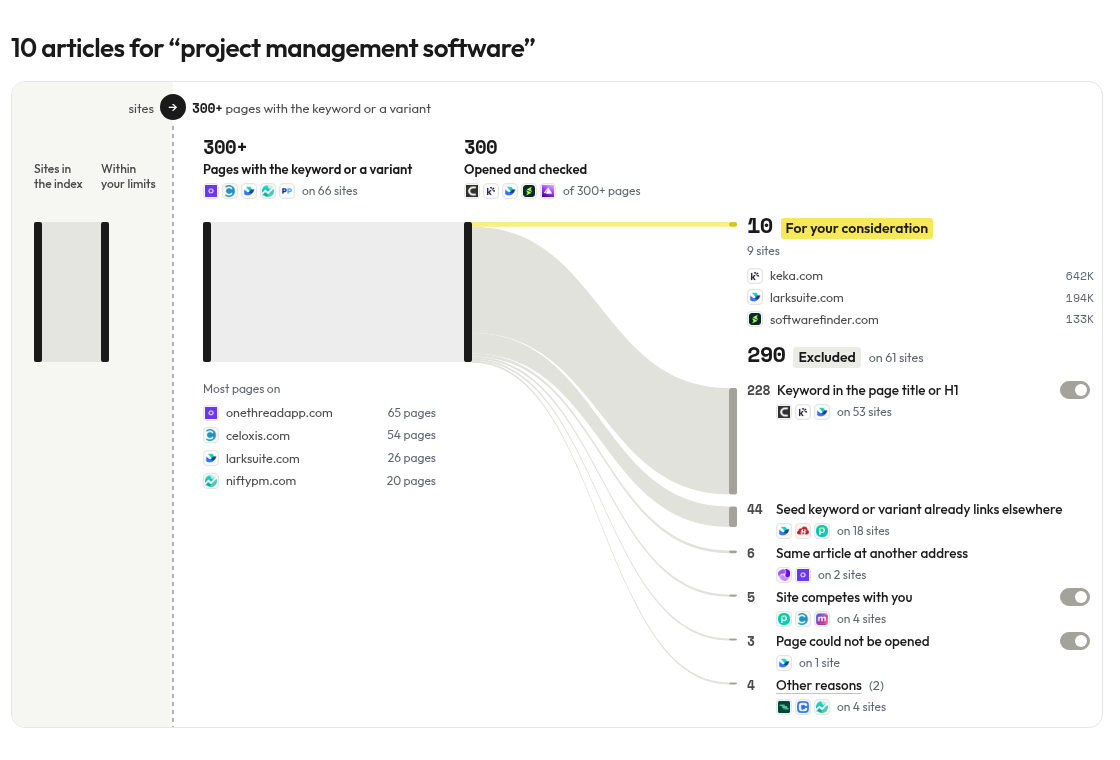
Before results reach you, an AI check opens the pages that contain your keyword or a variant and checks each one. It uses your page to promote to spot sites that compete with you. Only the pages that pass are listed for your consideration, and the check shows each page it left out with the reason:
- the keyword is in the page title or H1
- your keyword or a variant already links somewhere else
- the same article sits at another address
- the site competes with you
- the page could not be opened
You can also skip sites whose organic traffic fell 50% or more in the last 6 months. A site that has just lost half its traffic is a weaker host, however good the sentence looks.
The check narrows the list. It doesn't make the decision. Here's how I put it when talking about AI in link building:
"Ultimately, I would say it's still not possible to replace a human fully. You can automate a lot of stuff but also you can't just remove them from making some decisions."
That's why you still read the sentence and approve the page yourself. You know your target page better than any filter does. On host-page detail, I'll be straight: some marketplaces show more page-level metrics than we do, such as the page's own keywords and referring domains.
You choose between linking existing words and adding a new sentence
For each link, you give us the target page and the anchor text. Then you choose: link words already in the article, or add a new sentence. If the sentence already says what your page is about, linking existing words is the lighter change.
We place links through the editors and link builders who already work with these sites. We don't own or control the sites, and publishers have the final say on every insertion.
What to do with it: read the sentence with your anchor in place before you order. If it reads like an ad, ask for a new sentence instead.
You pay upfront and get a refund if the link doesn't go live
Prices start from $250 per link and depend on the site. You see a starting price for each article in the results and pay the full amount upfront by card. When the link is live, we send you the article URL to check.
We list 45 days as the safe upper limit, not the norm. You usually know within about two weeks whether a deal will happen, and many links go live by about 30 days. If the link doesn't go live, you get a refund.
The most common reason for a refund is that the editor sees you as a competitor, commercially or in search, so pick a different article if a site sells anything close to your product or ranks for your main keyword.
Once a link is live, keep checking it. Whichever marketplace you buy on, keep a record of what you ordered and check now and then that your links are still there.
To see the sentences for your own keyword, search by keyword on LinkVendors.
LinkVendors isn't the right fit outside SaaS, ecommerce and tech
Every site we list belongs to a software company. If your target page is far from software, ecommerce or tech, you won't find many articles where your link fits.
If your priority is building links for grey niches, LinkVendors is not for you. A general marketplace that specialises in other industries is the better fit.
Insert.Link lets you choose the page across 15+ niches
Insert.Link sells guest posts and link insertions across 15+ niches, from IT, SaaS and e-commerce to legal, health, finance and real estate. Around 12,000 of its sites are available for a link insertion.
Its core insertion feature is what it calls page-level intelligence: 50M+ indexed publisher pages with NLP-powered topical search. The flow on its homepage is short: enter a keyword, select relevant pages, get backlinks. So you choose the existing article, not just the domain. You provide the target URL, anchor text and requirements when you order.
Before you order, you review the publisher, the page, the page's metrics (traffic, keywords, DR and referring domains) and the price. That's a strong host-page view. Use it: check the page's keywords against your target page before you look at DR. If the page ranks for your main keyword, the editor may see you as a competitor.
Pricing for insertions needs care. Link insertions are their own order type, separate from guest posts, listicles, press releases and brand mentions. Its pages describe budgets from sites at about $20 to $25 up to top-tier publishers, but they give no insertion-only price. So ask for the insertion price before you order, and don't read that range as one.
Its stated guarantee is delivery according to the approved order: placement type, target URL, anchor text, publisher and page details, and brief. It says it does not guarantee rankings, traffic, indexing speed or visibility in AI answers. For an insertion, the important part is that the page is part of the approved order. An order that isn't accepted within 7 days is cancelled automatically.
A Fast Delivery Sites list shows publishers that can place links quickly, some in up to 3 days. Agencies get projects per client with budgets and order tracking, plus MCP and API access.
Best for: buyers who need link insertions outside SaaS and want page-level search.
FatGrid finds who sells an insertion on a domain you already chose
FatGrid is a price-comparison tool first. It compares 1.3M+ offers from 15+ marketplaces in one interface. For insertions, it answers one question well: who sells an insertion on this domain, and for how much.
Its Publisher Price Finder takes a domain or a list and shows the best price across marketplaces, with Semrush metrics on every result. When you browse, its 25+ filters include link type, so you can look at insertion offers on their own. Set that filter before you compare, so a guest post offer never shows up as the lower price. FatGrid's own FAQ says prices are pulled from marketplace listings and final prices depend on the marketplace, so confirm the price there before you order.
For finding hosts, Google Search Scanner takes a keyword and, FatGrid says, scans up to 200 Google results, then shows which ranking publishers accept guest posts or link insertions. Guest post and link insert prices appear in separate columns, next to the URL that ranks, so the two never blend. That starts from sites already ranking for your keyword, which is a sensible place to look for an insertion. An AI "Keyword Match" score rates relevance.
You can click Buy on FatGrid, paste your content, and it handles the placement on any marketplace it lists, with no accounts on those marketplaces. If it can't get the link published, it says you get a full refund to your bank card, not marketplace credit. After the order, Backlinks Monitoring alerts you when a publisher removes the content or changes link attributes.
Keep its plans apart from link prices. Pro is $34 a month with a 7-day trial, and Advanced is $199 a month. Those are fees for the tool, paid on top of whatever the insertion costs.
Best for: price-checking an insertion on a domain you've already picked.
iCopify keeps a separate insertion list, with escrow on every order
iCopify is a self-serve marketplace whose catalogue is mostly guest posts. Insertions sit in a separate section that lists about 4,800 websites for logged-in buyers.
A public list of sites that accept link insertions shows, per listing, the categories, traffic, Ahrefs DR, Moz DA, language, turnaround and a price. The URL is masked for guests, so you only see the site after you sign up. Once logged in, you can filter by DR, DA, traffic, niche, language, price and link type across 59 categories.
Many sites appear more than once on the public list. When we went through it, we counted about 2,700 listings but only about 1,350 distinct sites. Dedupe by site before you shortlist, or you'll compare a site against itself.
Most listings on the public insertion list show the same price, about $25, and they range from about $7 up to about $400. Treat the listed price as a starting point: the public list doesn't always match the price shown for the same site elsewhere on its pages, so confirm the insertion price at checkout. The "from $4.99" on its marketing pages is a guest post price, not an insertion price.
Payment runs through escrow. The publisher is paid only after the live URL is verified. If an order misses its deadline or the publisher declines, the balance returns to your buyer wallet.
Before you buy, you see each publisher's completion rate, turnaround time and response behaviour, and you can message them on the task page. For insertions, a low completion rate is a reason to skip a seller before you look at anything else.
Best for: buyers who want to vet insertion sellers by track record and are comfortable with masked listings until sign-up.
Insertion prices only make sense next to other insertion prices
In my experience buying link insertions, one on a plain blog that exists to sell links can cost about $50, while about $1,000 buys one in a good, ranking article on a high-metric site. The cheap end carries a risk I explain in how to buy backlinks, and it's why LinkVendors moved away from those blogs.
Three rules keep a price comparison honest:
- Same placement type. Compare insertion with insertion. Never average a guest post price with an insertion price, and never read a site's guest post price as its insertion price. A listicle addition is a separate product too.
- Same page. Two marketplaces may sell an insertion on the same site, but not in the same article. A lower price on a weaker page isn't a better deal.
- Fees counted in. Some tools charge a subscription on top of the link price, as FatGrid does. Add any fees to the link price before you compare.
You'll also see claims that insertions cost a fixed percentage less than guest posts. Those claims don't come with price data you can check, so don't budget with them.
The same site often sits on several marketplaces. My advice on buying links:
"If you're really looking for a good deal, shop around across multiple marketplaces, really. [...] and there is a big overlap in inventory for many of these sites."
What to do with it: price the same site on two or three marketplaces, insertions only, and compare the page each one offers.
An agency fits better when you want links you can't search for
Agencies charge per link, and many work from agreed requirements instead of letting you approve sites before buying. Those that do let you approve domains usually show you only a small slice of their inventory at a time.
On a marketplace, you see the full inventory, you can search it, and you approve the article and the sentence, not just the domain. An agency, or a digital PR team, fits when you want links on pages that aren't for sale anywhere.
For the full trade-off, read link building services vs marketplaces.
Run three checks on the host page before you pay for any insertion
Whichever marketplace you use, run these three checks on the actual page:
- The sentence fits your target page. Read it with your anchor in place. If you'd have to explain why the link is there, skip it.
- The page is live and doesn't already link your keyword elsewhere. Open it yourself. A dead page or a taken keyword is spend with no return.
- The site has a business behind it beyond selling links. Ask whether a link from it would still matter if its search traffic went to zero.
If all three pass, buy. If one fails, skip the page, however high the site's DR.
These three are specific to insertions, so run them on top of whatever checks you already use for any link.
If you build links for a software company, search by keyword on LinkVendors and read the actual sentences on 1,000+ established software company sites before you decide anything.