Link Insertions Explained: How They Work, What They Cost and How to Buy a Good One
 November 10, 2026

If you build links for a SaaS company or an agency, picture the kind of offers that reach you: a "DR 60+ niche edit" on a site that covers crypto airdrops, keto recipes and the best plumbers in Phoenix, a spreadsheet of "high-authority domains" with no article URLs in it, and a slot in a "top 10 project management tools" post that already links out to dozens of other tools. Every one of them is sold as a link insertion. None of them shows you a page worth paying for.
This article is for the SEO, growth person or founder who has been offered "niche edits" and wants to know what they'd actually be paying for. Here is the short answer. A link insertion puts your link into an article that is already live, on a page that is already indexed and often already ranks for multiple keywords. As a white hat buyer, you approve the exact site, article and sentence before you pay.
Most guides on this topic teach the outreach route. This one is written from the buyer's side: the scale I use to tell an insertion from something else, a real before/after insertion and the checks I run before I pay. I've been building links for more than ten years, first at GetFoundXL, then at my agency ClickCrab and now at LinkVendors.
A link insertion is a link added to an article that is already published
Nobody writes a new guest post. An editor opens an article that is already live and adds your link to it. That page is already indexed, and it often already ranks for multiple keywords.
You'll also hear it called a "niche edit" or a "curated link". It's the same thing under a different name. If you want to know whether link insertions are still relevant, I've covered that separately with data.
With a link insertion, you buy a page's existing position rather than a new page. That one idea explains how insertions work, what drives their price and how to pick a good one.
An insertion ranges from linking existing words to adding one sentence
You give two things for each link: the target page on your site and the anchor text. How much the editor changes the article puts the insertion on one of three levels.
- Exact match. The link goes on words that are already on the page. No words are added.
- A few words edited. One, two or three words are added or changed around the link so the anchor fits.
- One sentence added. The editor adds a single new sentence that carries your link, or edits a couple of existing sentences.
Exact match is the cleanest option when the article already uses your phrase. A new sentence works when the topic fits but the exact wording doesn't. On LinkVendors, you can ask for words already in the article to be linked or for a new sentence to be added, the two ends of this scale.
Adding a paragraph or a listicle entry is not a link insertion
Many guides, and Google's AI Overview for this search, count any link added to an old page as an insertion. I draw the line at one sentence. If the editor adds a whole block or paragraph, or adds your company as a new entry in an existing listicle, that's something else: a listicle addition, not a link insertion.
The difference matters when you buy. A new list entry or paragraph changes what the article says, so the editor is weighing a much bigger edit than a linked phrase. Know which one you're ordering, and compare prices only between the same type.
The index.dev insertion for Adobe Express shows what one added sentence looks like
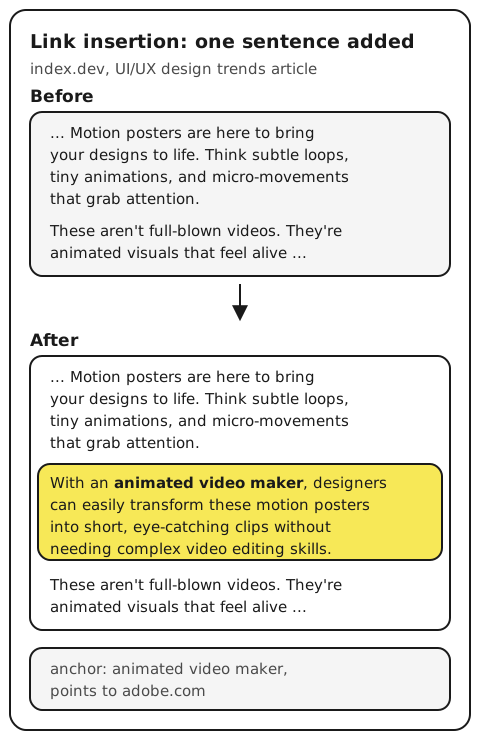
Here is a real, public example. The article is "The 12 Biggest UI/UX Design Trends to Watch in 2026" on index.dev. Before the insertion, a paragraph about motion posters read like this:
Static visuals are... fine. But in 2026, still images alone aren't enough. Motion posters are here to bring your designs to life. Think subtle loops, tiny animations, and micro-movements that grab attention.
These aren't full-blown videos. They're animated visuals that feel alive ...
After the insertion, one new sentence sat between those two paragraphs:
With an animated video maker, designers can easily transform these motion posters into short, eye-catching clips without needing complex video editing skills.
The anchor is "animated video maker", and it points to Adobe Express's animation page. That's level 3 on the scale: one sentence added, no other change. The inserted, linked sentence is still on the index.dev page.
LinkVendors tracks about 1,500 sites, almost all SaaS and software company sites with good metrics: the sites in the marketplace now, sites we dropped from it and sites that may join it. In a pilot sample from those sites (early-2026 snapshots compared with a late-October refetch), when an insertion added new text, the median addition was about 28 words, usually one sentence.
To find sentences like this for your own page, search by keyword on LinkVendors.
A good insertion sits in a sentence that already talks about your topic
The Adobe sentence works because the paragraph was already about turning designs into short animated visuals. The new sentence names a tool that does exactly that. A reader who wants to make a motion poster has a natural reason to click.
Fit is decided at the level of the sentence, not the domain. If the editor has to bend a sentence to make room for your link, the page is wrong.
Judge in this order: the sentence first, then the article, then the site. A strong site can't rescue a sentence that doesn't belong.
Link insertions and guest posts solve different problems
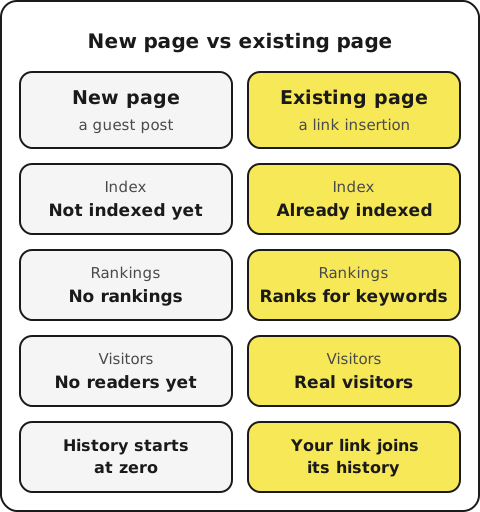
A guest post is a new article. It starts with no history, so it isn't indexed, has no rankings and has no readers yet. An insertion joins a page that already has all of that.
| Guest post | Link insertion | |
|---|---|---|
| What you get | A new article with your link in it | Your link in an article that is already live |
| Who writes | Someone writes a whole new article | The editor links existing words, edits a few words or adds one sentence |
| Page history | Starts at zero: not indexed, no rankings, no readers | Already indexed, often already ranks for multiple keywords |
Both have a place. If you want the full comparison, including when a guest post is the better choice, read guest posts vs link insertions.
The page's history is what you are paying for
Many vendors price insertions by domain metrics: DR, domain traffic, a niche label. But your link doesn't live on the domain. It lives on one page, and that page is what you're buying.
A site with a high DR can still have pages nobody reads. A page with real rankings and real visitors gives your link context, and it's already part of the web that search engines and readers use. That's the value of an insertion, and it comes from the host page, not the homepage.
So look at the page in plain terms:
- Does it rank? Put the URL into Ahrefs or Semrush and check that it gets organic traffic.
- For what? Look at the keywords it ranks for. They should be close to the topic of your target page.
- Does the topic match? Read the article. If your target page would be a natural next click for its reader, it matches.
What to do next: shortlist pages, not domains. A list of twenty domains is a starting point. A list of twenty articles, each with the sentence where your link would go, is something you can actually buy from.
There are three ways to get a link insertion, and each costs you something different
How you get insertions depends on what you have more of: time, money or people. There are three routes. Each one has a different cost when a link turns out to be the wrong one.
Doing outreach yourself takes weeks of emails, and reply rates keep falling
The DIY route has three jobs. You find the article, you find the editor who can change it, and you agree terms. Each step takes emails, follow-ups and waiting.
That route has been getting harder for years. AI makes it easy to mass-email people, so reply rates drop. And the people who sell links have mostly moved somewhere else:
"All the people who basically want to sell links, they're already in some kind of marketplace. And so [...] the economics don't really make sense anymore to reach out to people yourself."
For SaaS companies, the traditional route has been SaaS link exchanges: you link to a partner, they link to you. That works only if someone in-house has access to your own content and can add links to your site in return. If you don't have that person, exchanges aren't really an option. More on this in SaaS link building.
Most agencies charge per link and rarely let you approve the article or the sentence
An agency takes the outreach work off your hands and charges per link. Many agencies work from agreed requirements and don't let you approve sites before buying. Others let you approve each domain, but you approve a domain at best, not the article and the sentence, and you don't see the whole inventory the way you do on a marketplace.
That's how good and bad links get mixed. From the buyer's side, the lesson is simple: the best moment to reject a bad link is before you pay for it.
Marketplaces let you pick the page, but most list sites that exist only to sell links
A link building marketplace lets you browse sellers and order placements yourself. Big marketplaces list 100K to 1M sites. Most of those sites exist only to sell links.
To be fair, page selection is not rare. Some marketplaces, Insert.Link among them, let you search at the page level and pick a specific article. So choosing the page is not what separates one marketplace from another.
The real difference is the kind of site behind the page. A page-level search over a catalogue of link farms still returns link farms. If you're comparing page-level options, see Insert.Link alternatives for SaaS link insertions.
Link insertion prices are set per link and follow the site
You pay per link, and prices vary a lot by the type of link. Three things move the price:
- The site. A real brand with a strong domain costs more than a site built to sell links.
- The page. An article with real traffic and rankings for several keywords is worth more than one nobody reads.
- Who handles the edit. Getting a change made on a site with an editorial team takes more work than on a site that takes any link for a fee.
On LinkVendors, prices start from $250 per link and depend on the site. For what insertions cost across agencies and other sellers, see how to buy backlinks.
The money logic matters more than the price list. A cheap link on the wrong site costs more than an expensive one on the right page, because the cheap one buys you nothing. Every wrong link is spend you won't get back.
An insertion takes a few weeks, and you get a refund if it falls through
We list up to 45 days on LinkVendors, but that's the safe upper limit, not the norm. You usually know within about two weeks whether a deal will happen, and many links go live by about 30 days.
Some insertions never go live, and because you paid upfront, you get a refund. The most common reason is that the editor sees you as a competitor, commercially or in search.
A white hat insertion is one you approved before you paid
White hat is about two things: the kind of site and the process. The site is a real business, not a link farm. The process means you see the site, the article and the sentence, check them, and only then pay.
That order matters because every link is a spending decision. If you can't see what you're buying, you can't make that decision. You're just hoping.
Eight checks to run on every insertion before you pay
Copy this list and run it on every article before you order.
- The site belongs to a real business that earns from its product. Look for a product, pricing page and customers. If the site's only product is its blog, it earns from selling links.
- It has several traffic sources. A site that lives on search traffic alone is fragile.
- The article matches your target page. Your page should be a natural next click for someone reading that article.
- The sentence reads naturally with your link. Read it aloud with the link in place. If it sounds bolted on, skip it.
- Your keyword doesn't already link to someone else on that page. If the anchor you want already points to another site, your link is competing on the same words.
- The site doesn't compete with you, commercially or in search. A competitor has no reason to send its readers to you, and an editor who sees you as one will say no.
- The page is live and ranking. Check that it loads and gets organic traffic. A dead or invisible page has no history to sell.
- The page isn't already crowded with outbound links. An article that links out to dozens of sites gives each link less weight and less attention.
LinkVendors sells link insertions only on established software company sites
Since LinkVendors is my company, I've aimed to keep this section fair.
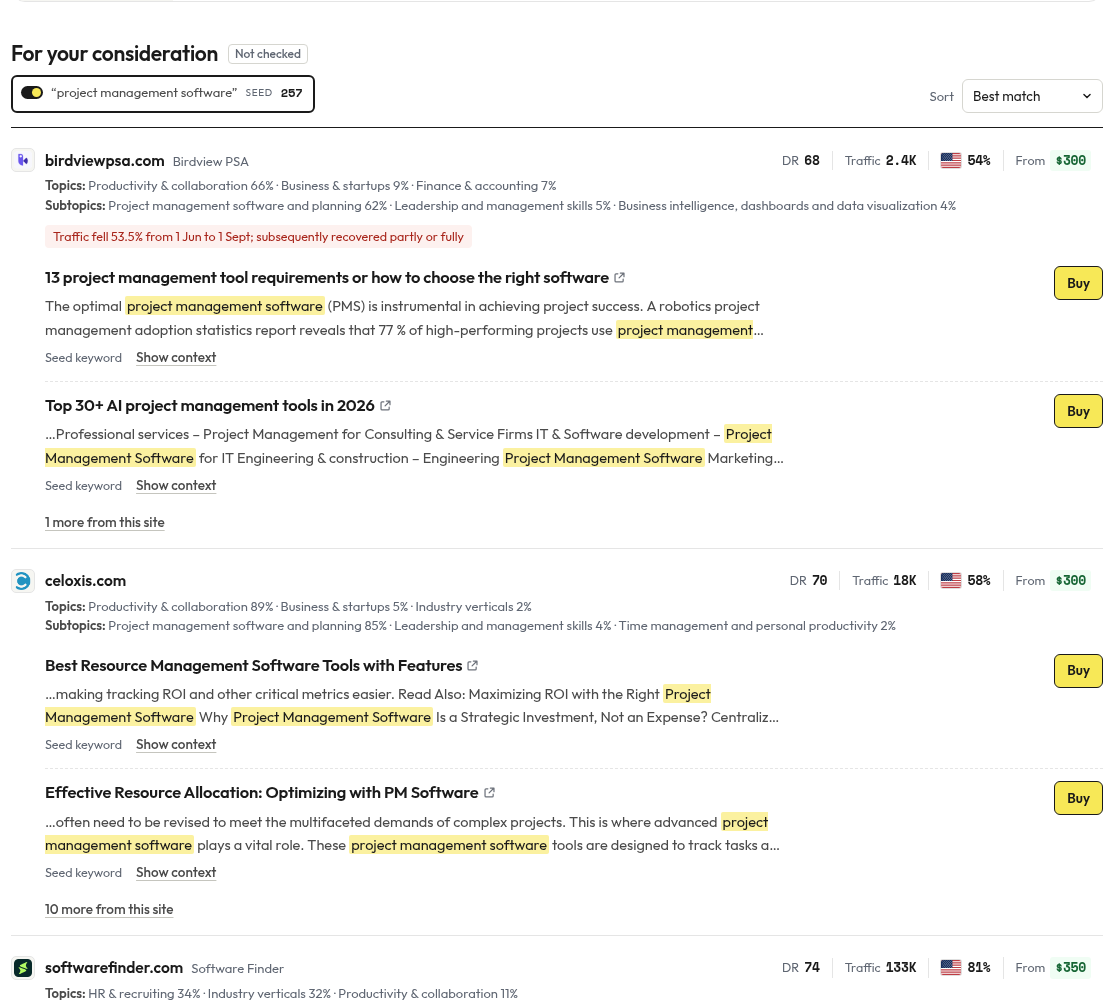
LinkVendors is a link insertion marketplace with 1,000+ established software company sites. Each one earns from its product, not from selling links. You search 1M+ published articles by keyword and add the page you want links to, and an AI check leaves out pages that won't work and sites that compete with you. You see the whole inventory, not a small batch of domains.
Each result shows the sentence with your keyword highlighted, the site's DR, traffic and US share of traffic, and the price. You approve the site, the article and the sentence before you order. Prices start from $250 per link, and you pay upfront and get a refund if the link doesn't go live.
For how this compares with other marketplaces, see the best link building marketplaces for link insertions.
Two checks decide whether a link insertion is worth buying
Everything above comes down to two questions you can ask about any insertion, from any seller.
- Does the sentence fit your page? It already talks about your topic, and your link reads as if it was always there.
- Would the site still matter if its search traffic disappeared? It's a real business with a product, customers and several traffic sources.
If both answers are yes, buy the link. If either is no, skip it, whatever the price.
Search by keyword on LinkVendors and approve the exact article and sentence before you order.