Link insertions are still relevant in 2026: companies still buy and sell them, and the site decides the value
 November 10, 2026

Picture this: AI Overviews answer the search before anyone scrolls, ChatGPT lists three tools in your category and yours isn't one of them, and in the budget meeting someone asks why you still pay for links. If you're the one who signs off link spend, as an SEO, a growth person or even a founder, you need an answer you can defend. Mine is that link insertions are still relevant in 2026, and the plainest evidence is that lots of companies still buy and sell them. Whether a given insertion is worth your money depends on the site it sits on.
You probably got here after an AI Overview told you yes, with quality caveats. That's true. It's just not much help when you're the one paying for the link.
I've built links for more than ten years, and I run a link insertion marketplace, so I have a stake in this. For this article we pulled market data: search volume, Google's live results for insertion searches and the size of insertion catalogues on other marketplaces. We also crawled about 1,500 sites that LinkVendors tracks, almost all of them SaaS and software company sites, comparing early-2026 snapshots with a late-October refetch to count links added into pages that were already published. I keep that data apart from my opinion, and I end with two checks you can run on any page before you pay.
The short version: the market for insertions is very much alive. Links still correlate with rankings, but no public study has isolated insertions from other kinds of links. In my view, the site a link sits on matters more now that AI answers sit above the results.
The doubt is fair, because AI answers now sit above the results
The worry isn't hype. If an AI answer sits above the results, some searchers will get what they need without clicking. How many depends on the search, and that's exactly why the question lands on your desk.
So a link that "only" helps you rank looks like a weaker purchase than it did a few years ago. If a ranking brings fewer clicks, the link behind it is worth less. That's the logic your CEO or CFO is running, and it isn't wrong.
There's an older doubt underneath it too. Some SEOs never buy links on principle. I've said before that this depends on who you are:
"[M]any SEOs pride themselves in never [...] buying any links, but the situation is very different for [...] a huge enterprise [site] with DR80 or [...] a startup or [...] an e-commerce store"
The right answer for a startup is rarely the same as the right answer for a big brand. For the rest of this article, I keep three things apart: what the market shows, what public studies show, and what is my opinion from building links. When something is my view, I'll say so.
Companies still buy and sell link insertions at scale in 2026
The clearest sign that insertions still matter is the market itself. People still search for them, vendors still fill Google's results selling them, and marketplaces still keep large catalogues of sites that accept them. None of that proves an insertion will move your rankings. It does show the practice hasn't gone away.
People still search for link insertions by name
In an Ahrefs export we pulled in late 2026, "link insertion" had 300 monthly searches in the US. It was the only insertion term in that export, so I won't guess at volumes for "niche edits" or "buy link insertions". Wider paid-link searches are bigger: "buy backlinks" showed 2,600 a month, and "buy links", "buying links" and "link buying" showed 1,200 each. Those aren't insertion searches and I don't add them together, but they show people are still shopping for links.
Google's results for insertion searches are full of sellers
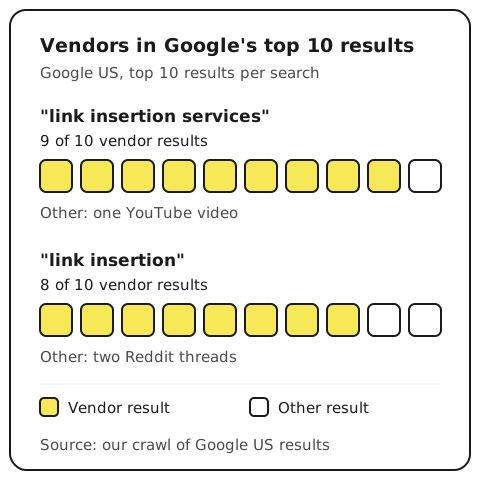
We also crawled Google's US results for seven insertion searches. For "link insertion services", 9 of the top 10 results were agencies or marketplaces selling or listing insertions or niche edits, and the tenth was a YouTube video about building them. For "link insertion", 8 of the top 10 were vendor guides or service pages, and the other two were Reddit threads. Across the top 10 of all seven searches, there were 46 different domains.
Google's AI Overview for "are link insertions still relevant" answered yes, with caveats about relevance and poor placements. That's a generated summary, not a measurement. It is, though, the answer your boss sees first.
Marketplaces still keep large insertion catalogues
General link marketplaces still sell insertions as their own product. Since LinkVendors is my company, it's on this list, and I've aimed to keep the figures fair. Here's what we found in late 2026:
- Insert.Link: 12,534 insertion hosts in an export from its API. Its homepage headline of 38,780 websites mixes guest posts and insertions.
- iCopify: 4,782 websites in the link insertion section of a buyer account, plus a public widget titled "2671 Websites & Blogs That Accept Link Insertions" (1,348 unique hosts).
- FatGrid: reports 224,831 insertion sites.
- linkbuildingmarket.place: lists 31,132 publisher websites and says "Link insertions start at $20" on its homepage.
- LinkVendors: 1,000+ established software company sites, all sold as insertions.
The same site often appears on more than one marketplace, so these counts don't add up to one market size. Each one still shows a business that builds its catalogue around insertions.
Outside the marketplaces, LinkPricer's 2026 niche edit pricing report analysed 62,023 domains that accept niche edits, nearly all from one supplier's database. Its median price was $41.90 and the average $76.82. BuzzStream's 2026 link building statistics put the average cost of a link insertion at $179. Those numbers show insertion inventory is still being collected, priced and sold, and they say nothing about whether those links are any good.
SEO surveys still treat buying links as normal
Editorial.Link's 2026 survey of 518 SEO professionals found 91.9% believe their competitors buy backlinks. In the same survey, 63.1% said they would place links on sites listed on link building marketplaces if the quality were right. Digital PR was voted the most effective tactic, at 48.6%.
Survey data on insertions specifically is thin. The same firm's 2024 survey of 113 SEOs found 15.9% saw niche edits as a solid strategy, and its 2026 write-up doesn't publish an insertion share. That gap is one reason we counted insertions directly in our own crawl, covered in the next section, instead of asking people.
A busy market proves insertions are alive, not that every one works
Lots of companies buying something doesn't make it effective. Plenty of the inventory above sits on sites that exist only to sell links. What the numbers settle is the "is this dead?" question: it isn't. The question worth your time is which insertions to buy, and that comes down to the site and the page.
Our own crawl shows link insertions still being added at scale
Marketplace catalogues show what's for sale. They don't show what actually gets added to real pages. So we looked for that ourselves.
We re-fetched the same pages months later and kept only links added into existing pages
We crawled about 1,500 sites that LinkVendors tracks: the sites in our marketplace now, sites we dropped from it (for example because we're no longer sure a link can be placed there) and sites that may join it. Almost all are SaaS and software company sites with good metrics, not random sites. This tracked set is wider than the 1,000+ sites listed in the marketplace today.
We compared early-2026 snapshots with a late-October refetch of the same pages and found outbound links that weren't there before. We kept only links added into pages that were already published, and removed rewrites and mirror-site duplicates. In the rest of this section, "sites" are the sites that carry the links, and "brands" are the companies being linked to.
An AI classifier assigned the labels, and we only lightly hand-checked them: in our pilot, 17 of 18 examples we checked by hand agreed with the classifier. It's not a formal study. It's a count of what changed on real pages.
Most insertions were one-off placements, not site-wide deals
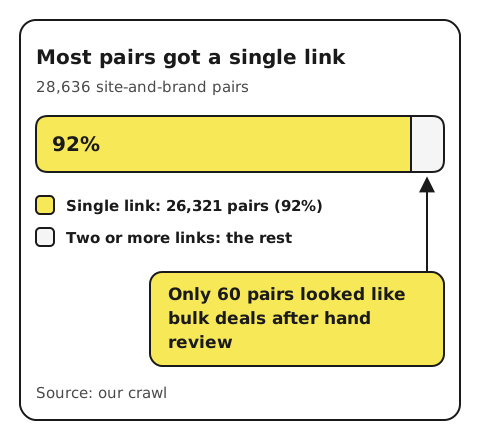
After cleaning, we had 31,641 link insertions across 28,636 site-and-brand pairs. A pair is one site linking to one brand. Of those pairs, 26,321 (92%) were a single link.
Bulk deals were rare. We hand-reviewed the pairs with five or more links, and 60 pairs out of about 28,600 looked like bulk deals. The pattern is one link, on one page, for one brand.
Many brands collect insertions across many different sites
1,493 brands appeared on five or more different sites within the six-month window. Among those brands, the median one appeared on 9 sites.
That's what steady link building looks like from the outside: the same brand turning up in already-published articles across many different sites. It isn't a few big deals. It's a lot of single placements adding up.
A typical insertion adds one sentence
In our pilot sample, when an insertion added new text, the median addition was about 28 words, usually a single sentence. That fits how I define the format. An insertion links words already on the page, edits a few words around the link, or adds one sentence.
Anything bigger, like a whole new paragraph or a new entry in a listicle, is something else.
The crawl shows links being added, not why or whether they work
The crawl sees that a link was added, not why. It can't tell a paid placement from a link exchange, and it says nothing about rankings, traffic or AI citations. I won't claim it proves insertions work.
What it shows is scale. Lots of companies still buy and sell insertions, and this data shows insertions being added into real pages tens of thousands of times in half a year. That's why they're still worth talking about in 2026.
The public data supports links in general, not insertions in particular
Most pages that rank for this question do one of two things. They cite studies about links in general, or they say insertions "work" with no data at all. Here's the plain version.
Links still correlate with rankings in the studies that exist
BuzzStream's roundup of 15 data studies on whether link building is dead concludes that links still correlate with rankings.
That's correlation, not proof. Pages that rank well also tend to be better pages from bigger brands, and both of those attract links. Anyone who calls correlation definitive proof is selling you something, and so am I, so read it the same way.
No public study has isolated link insertions from other links
I haven't found a public study that separates link insertions from other kinds of links. As far as I can see, the big studies count links. They don't record how a link got onto the page.
So nobody can tell you, with data, that insertions beat guest posts or the other way round. Anyone who says link insertions are proven to work is claiming something the data doesn't show yet. Our crawl doesn't change that either: it counts insertions, it doesn't measure their effect.
AI search also weighs brand mentions, which raises the bar for the site
BuzzStream's roundup also finds that AI search values brand mentions, not just links. The AI Overview for this very search makes the same point: AI-driven overviews also weigh unlinked brand mentions and digital PR. Again, that's correlation, not a measured effect of any one link.
What follows is my reasoning, not proven fact. AI answers lean on brands that real sites talk about. A link on a real software company's site is also a mention on a site with its own audience and reputation, while a link on a site that exists only to sell links is a mention nobody else trusts.
So the shift to AI search doesn't make the link format matter more. It makes the site matter more.
A link insertion lands on a page that already has a life
A guest post starts at zero. You pay, someone writes a new article, and then you wait to see if it gets indexed, read or ranked.
With a link insertion, your link goes into an article that's already published. The page is already indexed and often already ranks for multiple keywords. That changes what you're buying.
You can look at the page before you pay: its traffic, what it ranks for, the sentence your link will sit in, and where else it links. You're buying something you can inspect, not a promise.
The format has a weak spot too. You work inside someone else's text, so your anchor has to fit what's already there, or the publisher has to accept a new sentence. For the basics, read what a link insertion is, and for the trade-offs, guest post vs link insertion.
In my view, the insertions that hurt sat on the wrong sites
One Reddit thread that ranks for this search asks whether guest posts and link insertions are destroying organic traffic. My view, from more than ten years of building links, is that when insertions hurt, the problem is where the links were placed, not the format. That's a reading from experience, not a measured result.
So, in my view, the format didn't stop working. The sites did.
Big catalogues mostly list sites that exist only to sell links
Big link marketplaces list 100K to 1M sites, and most of them exist only to sell links. Picture the kind of page they'll happily offer you an insertion on: an old roundup of weight loss teas, a "best crypto bonuses" page stuffed with outbound links, or a "tech" blog that reviews payday loans on Mondays and VPN deals on Tuesdays.
If a page like that gets its readers from one source, Google, the link is worth nothing once that source drops.
Many agencies pick the sites for you, so good and bad links can mix
Most agencies charge per link, and many work from requirements you agree at the start, so you don't approve sites before buying. Others do let you approve each domain, but they usually show you a small slice of their inventory at a time. Neither model shows you the whole inventory or lets you approve the article and the sentence, so good and bad links can still land in the same report.
My view: Google and AI assistants trust links from real brands
This section is opinion. It's what I believe after more than ten years of building links: at GetFoundXL, where we built thousands of backlinks worth more than $2M, and since 2023 at ClickCrab.
Google and AI assistants like ChatGPT trust backlinks from real brands. Put your links on sites of software companies that earn from their product, not from selling links, and your links hold their value through search algorithm changes.
I can't prove that with a public study. What I can do is make it testable, so you don't have to take my word for it.
A real software brand gets traffic from many places besides Google
A software company's site doesn't live on Google alone. Its readers also come from its email list, its social followings, people searching the brand name, direct visits and customers who log in to the product every day.
Here's the test I use. Imagine the site's Google traffic dropped to zero tomorrow, and ask whether anyone would still read the page your link sits on.
For a SaaS company's site, the answer is yes, because its customers and subscribers still show up. For a site built to sell links, the answer is no, and the link was only ever worth what Google thought of that site that month.
I expect links from real brands to hold their value through algorithm changes
My view is that algorithm changes hit hardest at sites whose only purpose is to rank and sell links. A software company with paying customers has a different purpose, and its site keeps its readers whatever happens in search.
Read this as opinion from experience, not as a measured result. The traffic-to-zero test above is how you check it for yourself on any site.
Insertions are worth it in some cases and a waste in others
It depends, and the useful part is knowing on what. Every wrong link costs you the price of the link, the time spent choosing it, and the budget slot a better link could have used.
Worth it: a relevant article on a real brand that already ranks
You're a SaaS, ecommerce or tech company. You've found an article on a real brand's site that's relevant to your page, has real readers and already ranks. Your link fits a sentence without forcing it.
Buy it. This is where an insertion does the most: context, an audience and a page with a track record from day one. For the wider plan, see SaaS link building and link building for startups.
Not worth it: grey niches, one-traffic-source sites, pages nobody reads
If you're building links for grey niches, real software brands won't take your link. You'll end up buying from sites that exist only to sell links, so a marketplace that specialises in those industries is the better fit.
If Google is the only reason anyone visits a site, your link depends on one algorithm. And a page with no traffic and no rankings is overpriced at any price.
Not the right tool: anything truly unique belongs to digital PR
If you need something truly unique, like a data study picked up by news sites, that's digital PR, and it's a different job from link building. Insertions don't replace it, and I won't pretend they do.
Every insertion is a spending decision, so check the page before you pay
Every insertion you buy is real spend, so each one is a decision worth checking before you pay.
Here are the basics, in the order I'd check them.
Check the site: a product, several traffic sources, a mostly English-speaking audience
Start with the homepage, not the articles. If the company sells a product and has paying customers, it has a reason to keep its content alive and good.
Then look at where its traffic comes from in Ahrefs or Similarweb. A site with brand searches, direct visits and referrals will still have readers after an update, while a site that lives on organic traffic alone might not.
Check the audience's countries last. If you sell into English-speaking markets, a link on a site whose readers are mostly elsewhere sends you the wrong visitors.
Check the page: relevant, indexed, and your keyword doesn't already link elsewhere
The article should be about something your page helps with. Search for the URL in Google to confirm it's indexed, and check that it gets traffic and ranks for something.
Then look at the sentence where your keyword appears. If that keyword already links to another site, your link has nothing to add there.
Finally, make sure the page isn't dead and the site doesn't compete with you for the same searches. A competitor won't link to you for long.
Check the sentence: the link has to read like it was always there
You can ask for your link on words already in the article, or for a new sentence. Either way, read the paragraph out loud with your link in it. If it sounds like an ad, the publisher's readers will think so too.
For a real, public example of one new sentence that reads like part of the original paragraph, see the index.dev and Adobe Express insertion in my explainer on what a link insertion is, linked earlier.
Keep a human on the final call, even with an AI check
Tools narrow the list, but they can't replace a human fully. You make the final call.
How LinkVendors applies this to established software company sites
Since LinkVendors is my company, it's in this article, and I've aimed to keep this section to facts you can check. LinkVendors is a link insertion marketplace with 1,000+ sites of software companies that earn from their product, not from selling links, so the site check above is already done before a site gets listed. You search 1M+ published articles by keyword and add the page you want links to, and an AI check leaves out pages where your keyword already links elsewhere and sites that compete with you. Each result shows the sentence with your keyword, the site's DR and traffic, and the price.
You approve the exact site, article and sentence before you buy. You pay upfront and get a refund if the link doesn't go live, and prices start from $250 per link. For how this compares with other marketplaces, see the best link building marketplaces for link insertions.
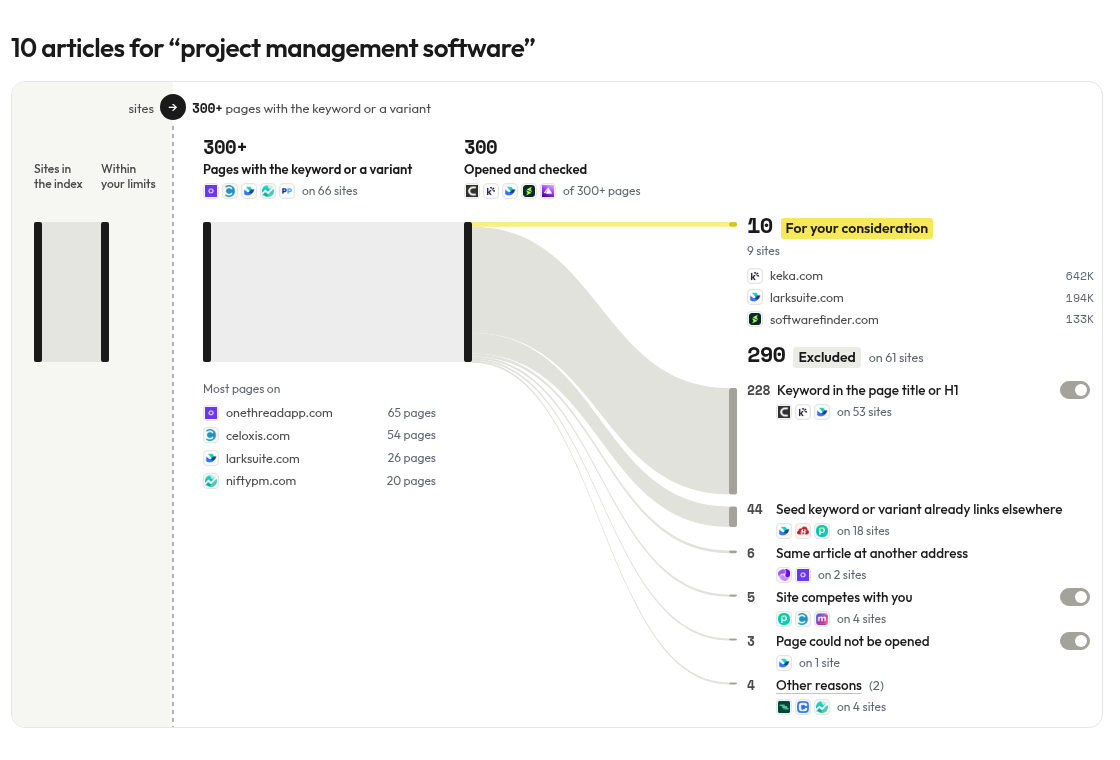
If you want to see what your own keyword turns up, search by keyword on LinkVendors.
Two checks decide whether an insertion is still worth it in 2026
The market has already answered whether insertions are dead. What's left is whether the one in front of you is worth buying, so run two checks on it.
First, imagine the site's Google traffic went to zero and decide whether the link would still matter. If the site is a real brand with customers, email subscribers and people searching its name, it would.
Second, look at the exact sentence on the exact page and decide whether you'd approve it as written. If you wouldn't, don't pay for it, whoever is selling it.
If both answers are yes, the insertion is worth it in 2026. To find pages that pass both, search by keyword on LinkVendors. For more on buying well, read how to buy backlinks.