Link Building for Startups: What to Do First, What to Skip and Where Your First Budget Goes
 November 10, 2026

Picture the offers a startup gets when it asks around about link building. A gig selling backlinks in bulk for less than a team lunch. A marketplace that brags about listing 1M sites, most of which you'd never want your logo near. An agency that charges per link and, like many agencies, doesn't let you approve the sites before you buy.
None of it is built for someone with a small budget and a lot to lose.
This is written for whoever owns SEO at a young SaaS company right now. That might be the founder, a growth person or the first marketer. There's no link builder on the team yet, and the money has to turn into traffic to a page that sells the product.
Advice that fits a big, established site doesn't always fit a startup. As I've put it before:
"Many SEOs pride themselves on never buying any links, but the situation is very different for a huge enterprise site with DR 80 than for a startup or an e-commerce store."
I've been building links for more than ten years. I co-founded GetFoundXL, where we built thousands of backlinks worth more than $2M, and since 2023 I've run ClickCrab, a link building agency. I also run LinkVendors, a link insertion marketplace, so I have a bias, and I'll point it out where it shows up.
This isn't another list of tactics. It's the order I'd do things in, what I'd skip, who should do the work, and how I'd spend and check a startup's first paid links.
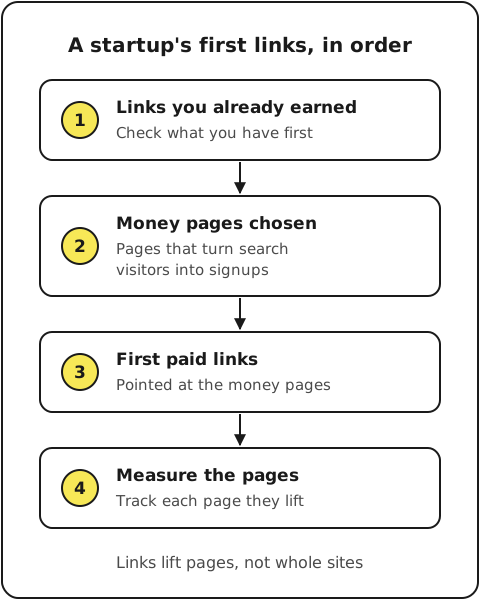
Buying links before you have a page worth ranking wastes the first budget
Links don't rank a website in general. They lift specific pages. If no page on your site can turn a search visitor into a signup or a demo, a link has nothing useful to lift.
So before anything else, check which side of that line you're on.
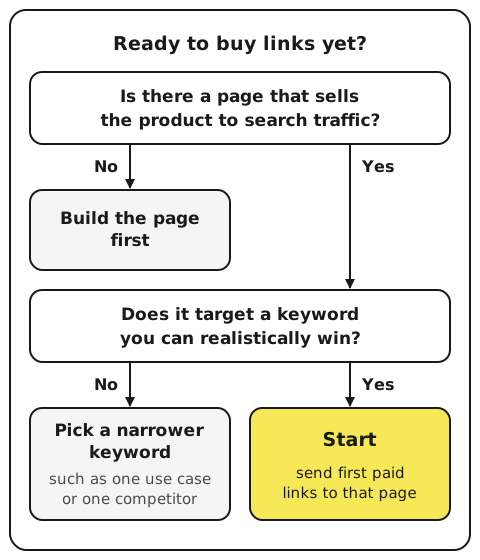
It's too early when no page on your site sells the product to search traffic
Picture an early SaaS site with a homepage, a pricing page and a login. That's fine for launch. It isn't a place to send paid links, because a homepage mostly ranks for your brand name, and people who search your brand already find you.
At this stage, the better use of the money is writing the pages themselves. Paid links can wait until there's something for them to lift.
It's time when a money page targets a keyword you can realistically win
The moment to start is when at least one page targets a search your buyers actually make, and that page would convert them if they landed on it. Think of a use-case page, a feature page or a comparison page against a bigger competitor.
"Realistically win" matters. A young domain going after the same head term as the category leader will burn money for a long time. A simple check is to search the keyword and look at who ranks: if the first page is all category leaders, pick a narrower keyword, such as a specific use case or a comparison with one competitor.
Every link a startup builds is a spending decision
I think about link building in terms of money, not tactics:
"If you're building links, every decision you make is attached to actual spend. Do I build this link or not? Do I buy it or not? Do I exchange it or not? Everything has value, and a series of mistakes can cost money."
For a big company, one bad link is a rounding error. For a startup, it can be a real share of the quarter's SEO budget. A wrong link costs you twice: the money, and the months you wait before you find out it did nothing.
So the rest of this article follows one rule. Spend where a small budget loses the least money.
Collect the links your company already earned before you buy any
Every startup guide lists the same sources here: integration partner directories, testimonials for tools you pay for, investor and accelerator portfolio pages, and unlinked mentions of your brand. They're worth doing because they cost time, not budget. Do them, then move on.
They're step one, not the plan. These links mostly point at your homepage, and your money pages still need their own. For the wider picture, see my guide to SaaS link building.
Pick the pages that make money before you pick the links
The first real job is choosing two or three target pages. Product, use-case and comparison pages are the usual candidates. Give each one a keyword it should rank for.
This is the part that separates link building from collecting links. When I think about what a senior link builder is paid for, it's the strategy: tying links to revenue and deciding which pages get them first.
Write the plan down before you talk to any seller. For each page, list the keyword, the anchor text you'd like, and the type of placement you want. Keep guest posts and link insertions in separate columns, because they're priced and delivered differently.
Most of the usual startup advice is safe to skip at the start
Some advice isn't wrong. It just doesn't fit a small team with limited money. Here's what I'd leave for later, and why.
Bulk link packages mix good and bad links you never approved
A package of links at a fixed price sounds simple. The catch is that with most packages you don't approve the sites in advance. Good and bad links get mixed into one delivery, and you find out which is which after you've paid.
With cheap packages you can sometimes filter by metrics, but that's not the same as choosing the site. They tend to run on sites the seller has bulk deals with, on links bought in bulk and resold to many clients, or on sites with inflated metrics.
Even a team that checks sites for a living can end up paying for a link on a site that has no business linking to a client, and a package you can't inspect removes the checking step entirely.
Building your own outreach machine rarely pays off for one startup
Cold outreach to buy placements used to be the default. Two things changed it: AI makes mass emailing easy, so reply rates keep dropping, and the people who sell links have already listed themselves on marketplaces. That means reaching out to them yourself rarely makes economic sense anymore.
Outreach still makes sense for things that aren't for sale: partners, mentions, a story you pitch. For paid placements, the sellers are already listed.
Digital PR is a different job from link building
Digital PR can earn great links. It also needs something newsworthy, a different skill set and a different budget. When you want something truly unique, you're in digital PR territory, and that's a completely different discipline from link building.
Come back to it when you have original data or a story only you can tell. It's not where the first budget goes.
A 1M-site marketplace sells volume, not relevance
Big link marketplaces list 100K to 1M sites. Most of them exist only to sell links. The size looks impressive on a dashboard, but sorting through it is the job, and a startup without a link builder doesn't have the hours.
On a marketplace that size you have to go really hard on the filters, and you'll still get junk.
Somebody in-house plus a marketplace is the best starting point for most startups
When people ask me who should do the work, it depends on the company. But for most, my answer is the same: one person in-house, working with a marketplace.
In SaaS, ecommerce or tech, that means a marketplace like LinkVendors (which I run). So weigh my view with that in mind. Here's how the other options actually behave.
Many agencies charge per link and choose the sites for you
Agencies charge per link, and some do good work. The catch for a startup is control. Many agencies work from requirements you agree at the start and don't let you approve sites before buying.
The ones that do let you approve domains usually show you a small slice of their inventory at a time, never the whole list the way a marketplace does. I go deeper on this in link building services vs marketplaces.
A part-time contractor rarely makes your startup their main priority
A contractor can run outreach for you. They also have other clients, and a small startup is rarely the biggest one.
"With a freelancer, you're getting somebody who's telling you to their face that you're not their main priority."
That's not a moral failing. It's how contracting works.
Hiring several agencies at once means they step on each other's toes
Some companies try to hedge by hiring more than one agency, and the agencies end up stepping on each other's toes. For a startup, it also splits a small budget into pieces too small to matter. Nobody owns the full picture.
Your in-house person owns the strategy, the link exchanges and the final yes
The in-house person doesn't have to be a full-time hire. It can be the founder or the first marketer. What matters is that one person owns the target pages, the anchors and the decision to buy.
Some work can only be done from inside the company. SaaS link exchanges are the clearest case: the person needs access to your content, to link out to partners and to add links on your own site. An outsider can't do that for you.
Exchanges trade links rather than money, so they still have a cost. Every link you receive usually means one you give from your own site, and someone has to keep track of both sides.
A marketplace replaces the outreach, not the judgement
A marketplace removes the weeks of emails. It doesn't remove the decision about whether a link is worth the money.
That's why the in-house person and the marketplace work as a pair. The marketplace finds and places. Your person decides.
Your first link budget belongs on a few relevant software company sites
With a small budget, I'd rather have a few links on established SaaS company sites than many links on sites that exist only to sell them. A software company has a product, customers and a brand to protect.
A link insertion adds your link to an article that is already indexed and often already ranks for multiple keywords
A link insertion is a link added to an article that's already published. No new guest post gets written. The page is already indexed and often already ranks for multiple keywords.
For a startup, that matters because you're not waiting for a new article to be written, approved and found. You can see the page before you pay for it. I explain how link insertions work in a separate guide.
Guest posts and link insertions are priced separately, so plan them separately
A guest post needs a new article written, approved and published. An insertion goes into a page that already exists. The work is different, so the prices are different.
Keep them as two lines in your budget, never one blended number. On LinkVendors, link insertions start from $250 per link, depending on the site.
The size of the first budget depends on how many money pages you need to lift
Start from the pages, not from a number someone quoted you. Take the two or three pages you picked, and decide how many links each needs to move. The budget follows from that.
Be careful with budget ranges you find online. They don't always say whether they cover guest posts or insertions, and they often come from the people selling the service.
Check every site and article before you pay
This checklist works on any marketplace or agency offer, including ours. Start with one test: would a link from that site still matter if its traffic went to zero?
Then go through the rest:
- A real business with a product. The site earns from what it sells, not from selling links.
- An article that fits your page. Someone reading it would plausibly want your page next.
- A keyword not already linking elsewhere. If the sentence already links your keyword to another site, your link competes with it.
- Not a competitor. A link from a company chasing your customers helps nobody.
You can spot most bad sites without paying for an SEO tool
Most marketplace listings, ours included, show a site's DR and traffic next to the price. That's enough for a first sanity check. Just remember what those numbers are:
"These metrics are models, so take them with a grain of salt. I treat them as red flags, not hard filters."
A flag means look closer, not reject. A hard filter on top traffic country, for example, would once have thrown out a link from Ahrefs itself, which at one point had India as its #1 country. Here are the flags a startup can check with no tool budget:
- DR and traffic out of sync. The two should roughly match. DR 88 with about 1,000 monthly visits makes no sense; a huge brand with neglected SEO can look like that, but it's rare, and usually it means the link gives poor value.
- A bad neighbourhood. Look at who the site links out to. Links to grey-niche sites are a bad sign, and so are sitewide links in the footer or sidebar.
- Heavy, aggressive ads. Some SEOs treat this as a negative signal, and experienced link builders weigh it when prospecting.
- Traffic that fell off a cliff. On LinkVendors you can skip sites whose organic traffic fell 50% or more in the last 6 months.
The full checklist, with the checks that need Ahrefs, is in things to verify before outsourcing link building. For the buying process itself, see how to buy backlinks.
LinkVendors lets you approve the site, article and sentence before you pay
Since LinkVendors is my company, this is where my bias shows, so I'll stick to what the product does. LinkVendors is a link insertion marketplace with 1,000+ sites of established software companies that earn from their product, not from selling links. You search 1M+ published articles by keyword and add the page you want to promote, and an AI check leaves out pages and sites that compete with you. Then you approve the site, the article and the sentence before you buy.
Prices start from $250 per link, depending on the site. You pay upfront and get a refund if the link doesn't go live, and we aim to get links live within 45 days. If you're outside SaaS, ecommerce or tech, or you mainly want grey-niche sites, a marketplace built for other industries is the better fit. I compare the options in best link building marketplaces for link insertions.
If you've picked your money pages, take the keyword of one of them and search by keyword on LinkVendors to see which software company sites already have a published article that mentions it.
Judge the first links by the pages they were meant to lift
You chose the pages before you bought the links. Judge the links the same way. Track rankings and organic traffic for each money page and its keyword, not your site's overall DR.
Start the clock from the date each link went live, not the date you paid. Links reach their pages at different times, so judging the whole round from the order date will make the early weeks look worse than they are.
Your site's DR will move as a side effect, and DR itself changes when Ahrefs moves to its new DR4 model on 1 December 2026. The question that matters is whether the pages that sell the product got more of the right visitors.
Two questions decide whether your startup should buy its first link now
You don't need a 30-day plan to decide. You need two honest answers.
- Is there a page worth ranking? A page that sells the product, targets a keyword your buyers search, and that you could realistically win. If not, build the page first.
- Is the site a real software business, not a link seller? If the site has a product and customers, the link is worth considering. If it exists only to sell links, skip it.
If both answers are yes, you're ready for your first paid link. Search by keyword on LinkVendors and approve the exact site, article and sentence before you buy.